


Choosing between Flutter and PWA is like deciding between speed and strength. One gets you to market quickly, while the other provides deep control over device features. Both work across platforms - but they suit different goals.
Let’s break it down for fintech: development speed, cost, and native access.
Flutter vs. PWA: what’s the difference?
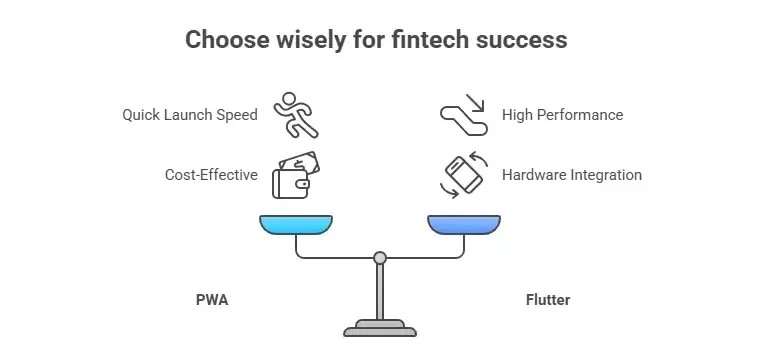
Imagine a bank needs an app - fast. One path offers a swift launch and low cost. The other delivers high performance and superior hardware integration.
- PWA (Progressive Web App): Runs in a browser. Quick to launch. Cost-effective.
- Flutter: Google’s cross-platform toolkit. Feels like a native app. Deeply utilises device features.
For fintech, the choice impacts everything from security to speed.
PWA development: fast, flexible, and browser-based
PWAs are swift. You bypass app stores.
Updates are delivered via the server, and users see changes immediately.
For fintech, that’s a significant advantage:
- Launch updates instantly.
- Avoid store review delays.
- Save on development and team costs.
Benefits of PWAs for banks
- Works offline - ideal for checking balances.
- Sends push notifications - great for reminders.
- Easy testing - uses standard web tools.
- Lower cost - no need for app-store builds or native developers.
However, there are limitations. PWAs don’t provide full access to hardware such as:
- Face/
fingerprint ID. - Bluetooth card readers.
- Background location tracking.
For simple apps, like balance checks or payments, this is sufficient. For complex tools? It may fall short.
“We launched a bank app in three months using a PWA. Reused their web code. Reduced costs by 30%.” - Industry Expert
Selected WislaCode projects


Flutter app development: full access and native feel
Flutter apps feel smooth and appear bespoke. They tap into device capabilities - from cameras to NFC.
Perfect for:
- Secure login (fingerprint, Face ID).
- QR and document scanning.
- Real-time trading or financial dashboards.
Yes, it takes more time:
- Requires building and testing for both iOS and Android.
- Dart developers are more expensive and harder to find.
- App store approvals can slow progress.
But the result is polished and powerful.
What Flutter does well
- High performance.
- Full access to device hardware.
- Bespoke UI with smooth animations.
- Ideal for fintech with complex logic or interaction.
“Flutter gave us biometric login and a seamless UI. It outperformed our web-only competitors.” - Fintech Developer
One drawback: Updates take longer. You must rebuild the app and resubmit to stores. PWAs don’t face this issue - they update instantly.
Flutter or PWA? It depends on your project
Here’s a quick comparison:
Feature | PWA | Flutter |
|---|---|---|
Speed to Launch | Very fast | Slower (app stores involved) |
Development Cost | Lower (common web tech) | Higher (Dart developers) |
Device Integration | Limited | Full access (camera, biometrics) |
Best For | Simple apps, payments | Complex apps, hardware integration |
Update Speed | Instant via server | Manual update + store resubmission |
Choose PWA if you need speed, low cost, and simple features.
Choose Flutter if you require a custom UI, hardware access, or real-time features.
WislaCode specialises in PWA development
We focus on creating Progressive Web Applications (PWAs) that deliver exceptional user experiences across all devices.
Why WislaCode Solutions?
We’ve built both PWA and Flutter apps for banks and fintech startups.
- Need a payment portal quickly? Opt for a PWA.
- Need biometrics, complex logic, or a custom UI? Flutter is the solution.
At WislaCode, we help you decide based on your actual needs - not trends. Whether you prioritise speed, security, or user satisfaction, we have the expertise to deliver.
Let’s discuss your fintech project. Tell us about your goals, and we’ll help you select the right technology to build it effectively.
What is the main difference between Flutter and PWA for fintech projects?
Flutter is a cross-platform framework from Google that enables you to build applications with a native feel for iOS, Android, web, and desktop, all from a single codebase. It provides extensive access to device features and supports bespoke user interfaces with smooth animations. A PWA, or Progressive Web App, is a web-based solution that operates in a browser but can also be installed on a device. PWAs are quick to launch, cost-effective, and simple to update, but they offer limited access to device hardware compared to Flutter. For fintech, the choice often hinges on whether you prioritise speed and simplicity (PWA) or advanced features and performance (Flutter).
When should a fintech organisation choose a PWA over Flutter?
A PWA is an excellent choice if you need to launch swiftly, keep costs low, and your application does not require extensive hardware integration. PWAs are ideal for straightforward banking tools, payment portals, or applications where instant updates and broad accessibility are more critical than advanced features. Opt for a PWA if you wish to bypass app store approval processes, your team is proficient in web technologies, the app’s core functions are simple, or you want users to access the app on any device with a browser.
What does scalability mean for fintech startups?
Scalability in fintech means building payment systems that can handle high transaction volumes. It focuses on security and adapting to regulatory changes. This helps platforms grow smoothly without performance issues, using modular designs and real-time analytics.
How can fintech startups expand fraud protection effectively?
To enhance fraud protection, fintech startups should use AI for real-time risk scoring and security measures. These tools quickly spot suspicious transactions, reducing fraud rates. This ensures a smooth user experience, even for platforms processing millions of transactions daily.
Why is a microservices architecture critical for fintech scalability?
A microservices architecture is crucial for fintech scalability because it allows services like payments and KYC to grow independently. This modular design and API-first development speed up updates, enable easy integrations, and ensure resilience during peak transaction times.
How do cloud solutions support fintech platform growth?
Cloud solutions like Kubernetes and serverless computing help fintech platforms grow. They enable auto-scaling, which supports high transaction volumes. Multi-cloud strategies reduce downtime risks, keeping platforms cost-effective and responsive during busy periods, like Black Friday.
What role does data analytics play in optimising fintech operations?
AI-driven analytics enhance fraud detection and personalisation, helping startups cut costs and boost customer engagement while maintaining performance.
How do regulatory frameworks impact global fintech scaling?
Regulatory frameworks like GDPR, PSD2, and AML/KYC are vital for fintech growth. They require platforms to integrate compliance into their core operations. Automated RegTech solutions simplify identity checks and data privacy, allowing fintechs to enter new markets quickly.
Why is automating payment processes essential for fintech growth?
Automating payment processes is key for fintech growth. It ensures efficient transaction handling through auto-scaling payment gateways and tokenisation. This reduces manual tasks, supports multi-currency payments, and meets PCI-DSS standards, building trust and enabling expansion.