

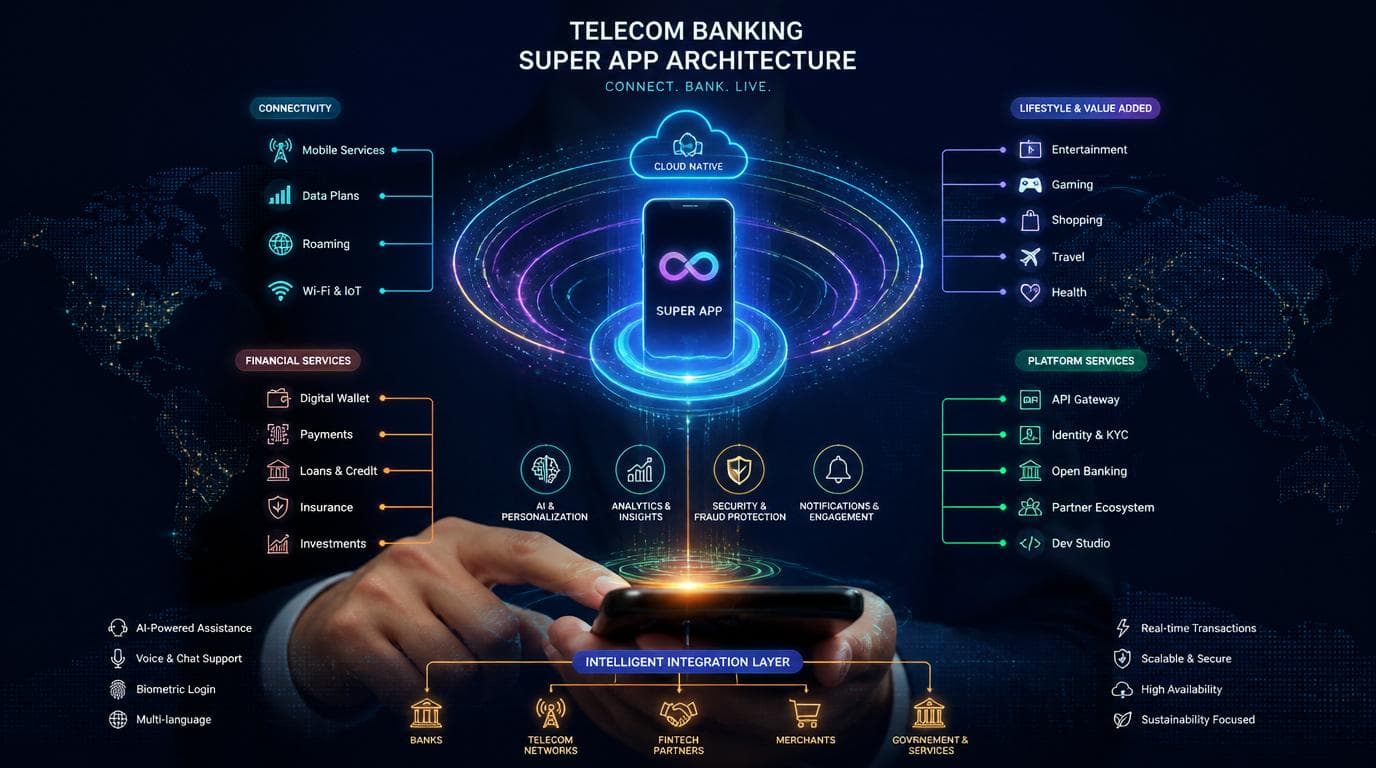
Most super app conversations start with the home screen. How many services fit under one icon? How many partner tiles sit on the first scroll? That is usually the least useful question.
A telecom banking super app becomes a real product when two regulated ecosystems agree to share distribution, trust, and daily operations through a single mobile entry point. This article is for CTOs, product leads, and platform architects who need to understand what that product requires before the feature list starts growing. It draws on practical experience with bank-telco programmes where the hard problems were never about adding another tile.
What holds a telecom banking super app together beyond the feature list?
Many programmes go wrong early because the team starts with a catalogue. Top-up, wallet, TV, loans, insurance, marketplace, rewards. The home screen becomes a negotiation between business lines, and the product starts expanding before it has a clear logic.
A better starting point is the exchange. What does each participant gain from being inside this product rather than beside it?
The exchange model that makes or breaks the partnership
Telecom brings frequency, reach, retail presence, and daily service moments. Banking brings money movement, cards, credit, compliance infrastructure, and stronger monetisation. When that exchange works, the app becomes a distribution engine. When it does not, the app becomes a crowded interface with no commercial centre.
A public bank-telco case made this visible. The real value was not that two brands shared a screen. The banking app became a daily telecom touchpoint. The telecom side became a distribution channel for the financial product. Both sides gained something they could not build alone.
That distinction matters because it changes how the team prioritises. If the exchange is strong, every new service reinforces the core loop. If the exchange is weak, every new service just adds weight.
Before discussing features, the team needs to answer a simple question. Why would each partner stay inside this product rather than launch their own app?
We specialise in creating digital ecosystems
These platforms bring together services such as mobile banking and telecommunications within a single application. This approach demonstrates how a single app can transform the way users interact with digital services.
Host app vs. mini-apps and why the shell must own more than navigation
Once self-care, payments, content, and partner services start multiplying, a flat interface stops scaling. You cannot keep adding tiles and still call the result coherent.
The app needs a host model. Core journeys like identity, money movement, telecom control, notifications, and support stay close to the shell. Other journeys can be modular. Some live as mini-apps. Some are partner-led modules under the host’s rules.
Whether the host is native, cross-platform, or hybrid, the principle stays the same. The shell must keep control of the things that should never fragment.
What the host app must own:
- Identity and authentication
- Payment primitives and wallet
- Navigation and permission model
- Error language and support entry point
- Notification bus and analytics taxonomy
- Core action placement (pay, transfer, top-up)
What modules can own:
- Vertical product flows (insurance, content, loyalty)
- Partner-specific interfaces and promotional surfaces
- Category browsing and discovery
- Self-contained service journeys
- Extended settings and preferences
The design system matters just as much as the code. Mini-apps do not make the experience simpler on their own. The host needs one visual logic, one error language, one support entry point, and one predictable way to move between money, service, and help. Without that, extensibility turns into clutter.
Why the integration layer and completion model decide whether the super app actually runs?
This is the part most teams still underdesign. They treat the integration layer as plumbing. In practice, it is the place where the ecosystem either starts behaving as a single system or stays a collection of isolated connections.
Shortlisting a platform to build this architecture on?
Our free white paper, The Mini-App Platform Scorecard, scores any vendor on seven criteria - from SDK openness and runtime portability to FINMA and DORA fit - with the exact question to put to each one.
What the API gateway must govern beyond routing?
In a telecom banking super app, trust between partners has to live somewhere concrete. In one programme I know well, trust between the operator and the bank was possible only because there was a neutral operating space both sides could rely on. Without that, every incident turns into an argument across black boxes.
In practice, this means a partner platform built around an API gateway and a shared evidence model. The gateway gives the mobile client a single stable front door. It routes, aggregates, protects, versions, and monitors traffic across services.
But the real value goes beyond routing. The integration layer needs:
- Versioned API contracts
- Idempotent operations
- Signed callbacks with webhook verification
- Clear retry rules and circuit breaker patterns
- A single transaction ID that spans all partners
- A support timeline that crosses bank, operator, and partner boundaries
Standards like PSD2 and Open Banking define parts of the API contract on the financial side. In a multi-partner super app, governance extends further. Partner onboarding certification, SLA enforcement, rate limiting, and degradation rules all belong in this layer. Without them, every new service makes the ecosystem larger but not easier to run.
Few successful projects of WislaCode

Modelling completion when charge, activation, and access live in different systems
Customers tap once and expect one result. In real super apps, completion splits into at least three events. Money is charged or reserved. The target service is activated. The user gets access.
Those steps may sit in different systems and sometimes in different companies. That is why “payment successful” can be technically true and commercially incomplete.
A lot of support pain starts here. Teams treat charge, activation, and access as one state. Then they wonder why the customer, finance, and support all describe the same incident differently.
These flows need explicit pending states, visible retries, and compensating actions when one step fails after another has succeeded. They also need a support view that explains what happened without guesswork. In ecosystem products, support is not a helpdesk add-on. It is part of product design.
Resilience fits here too. A telecom banking super app sits on top of services people use every day. When one partner slows down or fails, the customer rarely cares which team owns the problem. The platform needs feature flags, staged rollout, kill switches, rollback paths, and strong observability. Otherwise every new integration becomes a platform risk.
The easiest mistake in this category is to make the product look unified before it becomes operationally unified. If the exchange model, host architecture, integration layer, and completion model are sound, the feature list can grow safely. If they are weak, more services only make failure more expensive.
At WislaCode, this is the territory we work in. We build and modernise fintech mobile products with heavy integrations, real production constraints, and high expectations around control. In super app programmes, we think in modular domains with shared identity, wallet, and notification primitives, and we care about the host app, the API contracts, the rollout model, and the support view just as much as the first screen.
How does a telecom banking super app differ from a regular mobile banking app?
A regular banking app serves one organisation’s products. A telecom banking super app combines two regulated ecosystems into a shared operating model where the telco brings daily frequency and reach while the bank brings money movement, credit, and compliance. The result is a single mobile entry point that works as a distribution engine for both sides rather than a standalone channel for either.
How should a super app decide which journeys belong in the host shell and which can be modular?
Anything that touches identity, payment primitives, navigation, permissions, error handling, or support context should stay in the host. These are the elements that must never fragment across modules. Vertical product flows, partner interfaces, and self-contained service journeys can live as mini-apps or partner-led modules under the host’s rules.
What does a super app API integration layer need beyond basic connectivity?
It needs versioned API contracts, idempotent operations, signed callbacks, clear retry rules, a single transaction ID across all partners, and a shared support timeline. Without these, the platform can route traffic but cannot trace incidents, enforce SLAs, or give support teams a coherent view of what happened when something breaks across partner boundaries.
What goes wrong when a super app treats "payment successful" as the end of the journey?
Completion in a super app typically splits into three separate events: the charge, the service activation, and the user gaining access. These may sit in different systems or even different companies. When teams treat them as a single state, the customer, finance, and support end up describing the same incident differently, which drives up support costs and erodes trust in the product.
Do super apps need their own resilience strategy or can they rely on each partner's infrastructure?
They need their own. The customer sees one app and expects one level of reliability regardless of which partner owns the failing component. The platform needs feature flags, staged rollout, kill switches, rollback paths, and strong observability at the ecosystem level. Relying solely on individual partner infrastructure leaves the super app exposed every time a new integration is added.