


The financial sector is changing fast, and super apps are leading the way. These platforms bring payments, lending, rewards and lifestyle services together, which makes it easier for banks and fintechs to reach customers. From years of building software, we have seen how a solid super app strategy lets a financial institution take charge of the ecosystem. Here is how super app monetisation and banking super app development drive that shift.
Making money from a fintech super app
Super apps are digital platforms that combine services. They give users value and give providers income. Monetisation is about using daily interactions to build several income streams, such as transaction fees and premium subscriptions. By embedding key services like payments and rewards, super apps become essential, which lowers churn and lifts profit.
Why are super apps good at monetisation? They build habitual use, which makes cross-selling easy. Offering a loan after a big purchase, or insurance when someone books travel, raises revenue without an outside campaign. Super apps also open B2B options through data: they share anonymised insights with partners while staying compliant.
Key drivers of super app monetisation:
- Frequent engagement: services like bill payments or messaging bring users back daily.
- Cross-selling: targeted offers lift revenue per user by 20-30%.
- Network effects: more users and partners make the platform more valuable, which keeps it growing.
Super apps turn routine interactions into revenue by anticipating what users need.
A flexible platform is essential. Modular architecture makes it easy to add new services, so payment monetisation and other revenue models can adjust as the market changes.
Few successful projects of WislaCode


Building a banking super app: a roadmap
Building a super app is complex but rewarding. It needs a scalable, secure, user-focused technology stack. Banks already hold two valuable assets - customer trust and data. A super app uses both to offer integrated services, from payments to wealth management, on one platform.
Platform strategy: building a scalable ecosystem
A super app platform strategy builds an ecosystem where banks, fintechs and third parties share value. Unlike standalone apps, super apps act as digital marketplaces, run on clear rules and open interfaces. That drives network effects: the platform gets more valuable as it grows.
To do this, put modularity first. Microservices let you add features like loyalty programmes or SME tools without disrupting the system. APIs handle third-party integrations, and an API gateway makes partner onboarding simpler and more secure.
Here is how a platform strategy takes shape:
Component | Purpose | Advantage |
Microservices | Modular features for payments, lending | Quick updates without system downtime |
API Gateway | Manages third-party integrations | Secure and efficient partner access |
Data Governance | Controls data access and user consent | Builds trust and ensures compliance |
This base supports scale and change, so a super app grows with customer needs. A consistent experience across services keeps navigation clear and users engaged.
Payment monetisation: turning transactions into profit
Payments are the backbone of monetisation. Each transaction earns a small fee that, at scale, adds up. A platform handling millions of payments a day turns modest margins into real profit.
To get the most from payments, add value-added services:
- Loyalty rewards: encourage repeat use with points or cashback.
- Instant credit: offer loans at checkout and earn interest.
- Merchant solutions: give SMEs analytics and share their revenue.
The technology has to hold up. Real-time payment processing, strong fraud detection and a clean experience keep transactions secure and efficient. Cloud infrastructure and solid identity management handle high volumes reliably.
Payments power super apps, turning every transaction into a chance to build loyalty and revenue.
Data monetisation: insight for B2B revenue
Data is a rich source of revenue. By analysing behaviour - spending, travel or investment habits - a super app produces insights for B2B partners. Retailers might buy targeted ad data; insurers might tailor policies to lifestyle trends.
Strict governance is non-negotiable. Key practices:
- Access control: use OAuth 2.0 to limit partner access to data.
- User consent tools: give users a dashboard to manage data sharing.
- Secure handling: encrypt data to protect privacy.
At scale, data can earn millions a year, but it needs a large, active user base and frequent use to produce useful insight.
Modular super app solutions
WislaCode creating unified platforms that combine multiple services into one seamless and secure experience.
Choosing a platform to build and monetise your super-app on?
Our free white paper, The Mini-App Platform Scorecard, scores any vendor on seven criteria - from SDK openness and runtime portability to FINMA and DORA fit - with the exact question to put to each one.
The technical foundation of super apps
A super app's success rests on its technology. Development needs a stack that balances performance, security and flexibility. The core parts:
- Single sign-on (SSO): one login for every service, which improves retention.
- Unified design: consistent navigation and styling across mini-apps.
- Scalable cloud: supports millions of transactions reliably.
- Real-time data processing: enables timely insight for data monetisation.
Security is critical. Fintech-grade encryption, audit logs and role-based access keep you compliant with rules like GDPR. Without them, a platform loses user and partner trust, which undoes the whole strategy.
Why super apps matter
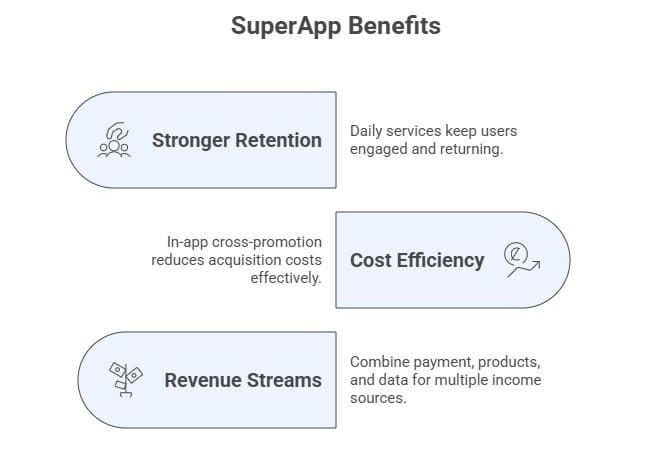
Super apps are reshaping finance by weaving services into daily life. They help banks and fintechs keep customers, cut costs and diversify revenue. The benefits are clear:
- Stronger retention: daily services like payments keep users engaged.
- Lower costs: in-app cross-promotion reduces acquisition spend.
- More revenue: combine payments, financial products and data for several income streams.
There are challenges too, such as high development costs and regulatory hurdles. A phased approach lowers the risk: start with basic services like payments and expand gradually. Putting APIs and user experience first from the start sets you up for the long term.
Next steps for financial institutions
Super apps are a chance to lead in finance. To start:
- Identify core services: begin with payments or lending, then add complementary features.
- Adopt modular technology: use APIs and microservices for flexibility.
- Focus on trust: deliver a clean experience and strong security.
- Partner with experts: work with a technology provider experienced in fintech.
Banks and fintechs that want to move on this should partner with a skilled development team to speed up the journey. A well-run super app strategy puts an institution in front for the future of finance.
What are all-in-one financial platforms, and how do they transform the user experience?
All-in-one financial platforms combine a variety of services - such as payments, lending, and rewards, within a single application. This integration streamlines daily financial tasks, offering users a seamless and convenient way to manage their money and access lifestyle services.
How do integrated digital ecosystems and unified banking applications benefit financial institutions?
By building integrated digital ecosystems and unified banking applications, banks and fintechs can offer a consistent user experience across multiple services. This approach not only increases customer satisfaction but also encourages more frequent engagement, helping institutions stay ahead in a competitive market.
What is the importance of platform-based revenue models and cross-service user engagement in super apps?
Platform-based revenue models allow super apps to generate income from diverse sources, such as transaction fees and premium features. When combined with strong cross-service user engagement, where users interact with multiple features. These models drive sustainable growth and open up new monetisation opportunities.
How does modular fintech architecture support the scalability of super apps?
A modular fintech architecture enables developers to add or update features independently, ensuring the platform can quickly adapt to changing customer needs and regulatory requirements. This flexibility is crucial for maintaining a secure, scalable, and future-proof super app.
Why is API-driven third-party integration essential for super app success?
API-driven third-party integration allows super apps to connect with external partners, expanding the range of available services. This not only enhances the user experience but also makes it easier for banks and fintechs to innovate and respond to market trends.
How does data-driven personalisation in finance improve both user satisfaction and monetisation?
Data-driven personalisation uses user insights to deliver tailored recommendations and offers. By understanding individual preferences, super apps can boost engagement, increase customer loyalty, and encourage the adoption of premium features or additional products.