

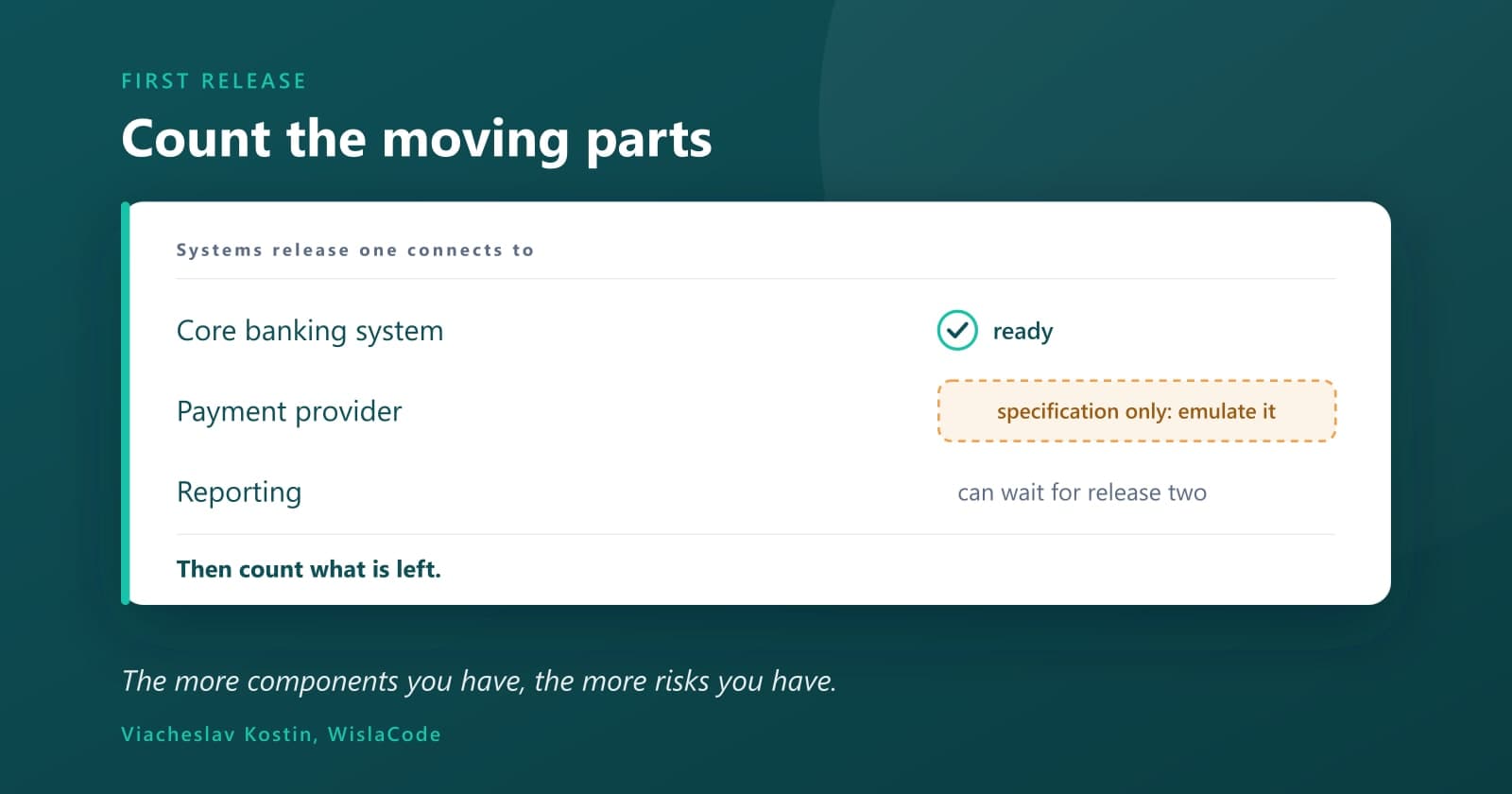
In every project, I suggest how to build the MVP to minimise time to money for the customer, and to deploy the service as fast as possible and as cheaply as possible.
The more components you have, the more risks you have, and the more effort you have to put into that. The less friction between components, the better.
Find the moving parts before you estimate
We usually do an exact estimate after preliminary work. We interview your employees, we interview you, to understand the capabilities of the organisations we need to integrate with. It's like consultancy work. We do it from the start, and after that you receive an artefact you can use with us or without us. It gives you the details for a sharper, concrete estimate. Without such discovery work, the estimate will be very, very preliminary.
Usually I suggest that such a discovery is no longer than two months, because if you make it longer, it will not happen. We will minimise budgets and timing there, and we will understand all the gaps. Maybe not all the gaps, but we will understand the risks involved. After that, it will be easier to prioritise: on business benefits, but also on the bottlenecks and risks we found.
When a provider is not ready
There could be several scenarios. From our experience, sometimes we switch to another functionality, because we have already done phase zero, the discovery, and we know what to do. We have to keep the team running because it's effective, and after that you will not spend time getting back to this speed.
The second scenario: we build stubs, an emulation of what we expect from the company. For example, you have chosen a provider, but haven't signed yet. They didn't give us anything, like a sandbox or something. But they can give us a specification, and we will build an emulation of that system according to the specification, and we will test with that. Of course, that's a bit of overwork from our side: additional effort, but not double, because you have to implement the specification in any case. We just build an additional answering part, which emulates fake answers.
You will see how it looks and how it works in the service, and when they are ready, we will open the integration. Of course, there will be some adjustments after that. That's real life. But we will not lose time there.
Map the moving parts before the estimate
If you are planning a first release, we can go through the systems it connects to with you, and what to do with each one that is not ready.
Building the target architecture in parts
The architecture is complex, but it has to be agreed together with the client, and for the long term. It has to be looked at right away and chosen as a direction. It will be complex in the end, but we don't have to build it as a big bang from day one.
For example, with my team, in one bank we moved off the internet bank that sat in the core banking system, an internet bank for small businesses. It came with the core system as a package. It was clunky and badly built, from the century before last. Everyone cried over its design and usability, and kept using it. Big corporate clients keep putting up with that, because the people who make the decisions don't have that problem. The pain never comes out. For SMEs it doesn't work like that. So the decision there was to move it in parts.
For a while, part of the internet bank already worked on the new rails, through an orchestrator and a normal interface, and part of it went by redirect to the old one. We thought clients would complain loudly: what is this rubbish? On the contrary, they praised it a lot and asked when the new features would finally appear on the new interface. Little by little they migrated, until the old interface was switched off completely. It means we work and improve right now, instead of paralysing the bank's work for a year.
Another way, or another provider
Usually I suggest minimising the risks, for us and for the customer. When that is not possible and the customer doesn't want to go with my approach, usually we find something suitable. But we have also had experience of starting with time and materials from scratch, and of working at a fixed price for the whole project, or with every stage of the project at a fixed price. It depends on the maturity and the readiness of the customer.
I tell a customer to find another solution or another provider only in cases where we are not 100% sure that we will deliver the best result, because of a lack of competence, or a lack of something else. We don't take on projects that we can't deliver at the right level of quality. And if we take one on, we do it properly.
Before you sign off the plan
List every system that release one connects to and your team does not control. For each one, ask:
- is it ready, or do you only have a specification;
- can it be emulated from that specification and tested against;
- can it wait for release two.
Then count what is left.
Plan release one with us
Tell us what your first release has to connect to, and we will tell you how we would approach it.
How long should discovery before a first release take?
Usually no longer than two months, because if you make it longer, it will not happen. It ends with an artefact the customer can use with us or without us, and it gives the details for a concrete estimate. Without it, the estimate stays very preliminary.
What if an integration provider is not ready when the build starts?
One option is to switch the team to another functionality that discovery has already defined. The other is to build stubs: an emulation of the provider's system according to its specification, and to test against it. That is additional effort, but not double, because the specification has to be implemented in any case. When the provider is ready, the integration is opened and adjusted.
Does a legacy internet bank have to be replaced in one go?
No. The target architecture is agreed with the client for the long term and built in parts. In one bank, part of the internet bank for small businesses ran on the new rails while the rest redirected to the old one, until the old interface was switched off.