
Data Science & AI Services
AI and machine learning for regulated fintech and banking. Decisioning, predictive models, generative AI, assistants and search, built inside the compliance boundary you already run.
Results from work we have shipped
Shortlisting a software development partner?
The questions to ask in an RFP, three warning signs a vendor may not deliver, and a scoring matrix to compare contractors objectively.
Eight ways teams engage us on AI and ML
Eight sub-services, each with its own page. Most teams start with AI development; the others go deeper on a discipline.
Autonomous and assisted AI agents that gather inputs, call your systems, apply your rules and escalate the edge cases, with a full audit trail.
See the service 02AI chatbot development servicesBanking assistants that resolve routine queries from your own content, cite sources and hand complex cases to live agents.
See the service 03AI development servicesApplied AI built into your product - agents, computer vision, NLP and decisioning, integrated into your stack and compliance boundary.
See the service 04AI integration servicesAI integrated into the product you already run - models, LLMs, APIs and agents wired into your stack, with monitoring and guardrails for production.
See the service 05AI-driven search tools developmentCustom AI search that unifies documents, tickets and CRM into one secure, role-controlled index with context-aware, ranked answers.
See the service 06Generative AI developmentLLMs and generative AI in production - RAG, fine-tuning and guardrails, deployed privately inside your boundary.
See the service 07ML development servicesCustom ML models trained, deployed and kept healthy - predictive, recommender and risk models with the MLOps to run them.
See the service 08MLOps developmentMachine learning operations that keep models useful in production - deployment, monitoring, drift detection, retraining and a model registry.
See the serviceHow we work with regulated AI
Most regulated operations hold data they cannot pass to a public model provider: customer records, transaction history, decision logs and internal policy. Sending that out for training or inference can be a regulatory event in itself, yet it is exactly the data an assistant or a decisioning model needs to be useful.
We design for the boundary from the start: self-hosted or private-endpoint models where capability allows, retrieval patterns that keep your data on your infrastructure while a strong model only reasons over what was retrieved, and contractual limits on any third-party endpoint. The boundary is the design constraint, not a finishing detail.
Our WislaSearch pattern is one example: retrieval over your internal documents, databases and APIs, run on-premise with no external data transfer. See it in production in the AI search assistant case.
A lot of AI work fails because the technique was chosen before the problem was understood. We start from the decision the business needs to make, the data behind it and the bar it has to clear, then pick the simplest approach that clears that bar. As a rough guide:
- A rules engine where the logic is known, stable and must be exactly auditable.
- Classical ML where the task is prediction over structured data, such as scoring or ranking.
- A language model, built on generative AI, where the input is language: documents, queries, conversations.
- A hybrid where a model proposes and deterministic rules constrain what it can decide.
Where the question is really analysis rather than a model, that is data analytics. The simpler choice is not a compromise. It is usually cheaper to run, easier to explain and easier for your team to own after handover.
AI and ML work carries more uncertainty than a standard build, so we structure the commercial model around proving value early. A proof of concept on your own anonymised data is a fixed-price, time-boxed piece with a clear question to answer: does the model clear the bar your use case needs.
If it does, production work follows as time and material or an outcome-based arrangement, with governance, monitoring and audit logging built in from the first sprint. If the proof of concept says the data or the use case is not ready, you have spent a small fixed amount to learn that, instead of a large one to discover it late.
An AI system that only the vendor understands is a liability, so we structure the engagement so your people learn it while it is being built. Our named lead works in the open with your data owners, your compliance function and the engineers who will run the model, and the reasoning behind each design decision is written down.
Knowledge transfer is continuous, not a final phase. By handover your team has already operated the system, and the questions that usually surface after a vendor leaves have been asked while we were still in the room. You own the source, the pipelines, the model artefacts and the documentation.
Not every question needs a model. A lot of the value in a regulated operation comes from data science in the older sense of the term: understanding what the data already says. A cohort analysis that explains why a segment leaves, a forecast that sizes next quarter's load, an experiment that settles whether a change actually moved the number.
We treat that as the same discipline as model building, because the honest answer to “should we train a model here” is often “analyse the data first”. Where the goal is to understand rather than predict, our data analytics service is the right entry point, and we will say so rather than sell a model you do not need.
It is also the cheapest way to find out whether a larger AI investment is worth making. A short, honest look at your data shows what is learnable before you fund a full build.
We collaborated with WislaCode on a route-to-market optimisation project. Working with WislaCode was effective, transparent and predictable, which is especially critical for AI and ML projects. We provided them with six months of anonymised data, and within just three weeks, they delivered a proof of concept that already showed...
Which service do I need?
If you want an AI capability inside a product, start with AI development. If you need custom models and predictions from your data, that is ML development. If you are building on LLMs, RAG or fine-tuning, that is generative AI development. If you need to wire AI into a product you already run, that is AI integration; for agents that carry out a task, AI agents development; and for keeping models healthy in production, MLOps development. For a chatbot or for smart search there are dedicated pages. Not sure - tell us the decision you are trying to make and we will point you to the right one.
Do you work only with fintech and banking?
That is where we are strongest and where the compliance constraints are hardest, but the same patterns apply to any regulated operation that cannot send its data to a public model.
How do you keep AI inside our compliance boundary?
Self-hosted or private-endpoint models where capability allows, retrieval that keeps your data on your infrastructure, contractual limits on any third-party endpoint, and audit logging where the use case requires it.
How fast can you prove value?
A focused proof of concept can land in weeks. On a route-optimisation engagement, three weeks on six months of anonymised data showed 30% less travel time and 20% more visits per day before any full build started.
Who owns the model at the end?
You do. Source code, feature pipelines, training scripts, model artefacts and documentation are handed over, and the system runs in your cloud from the start.
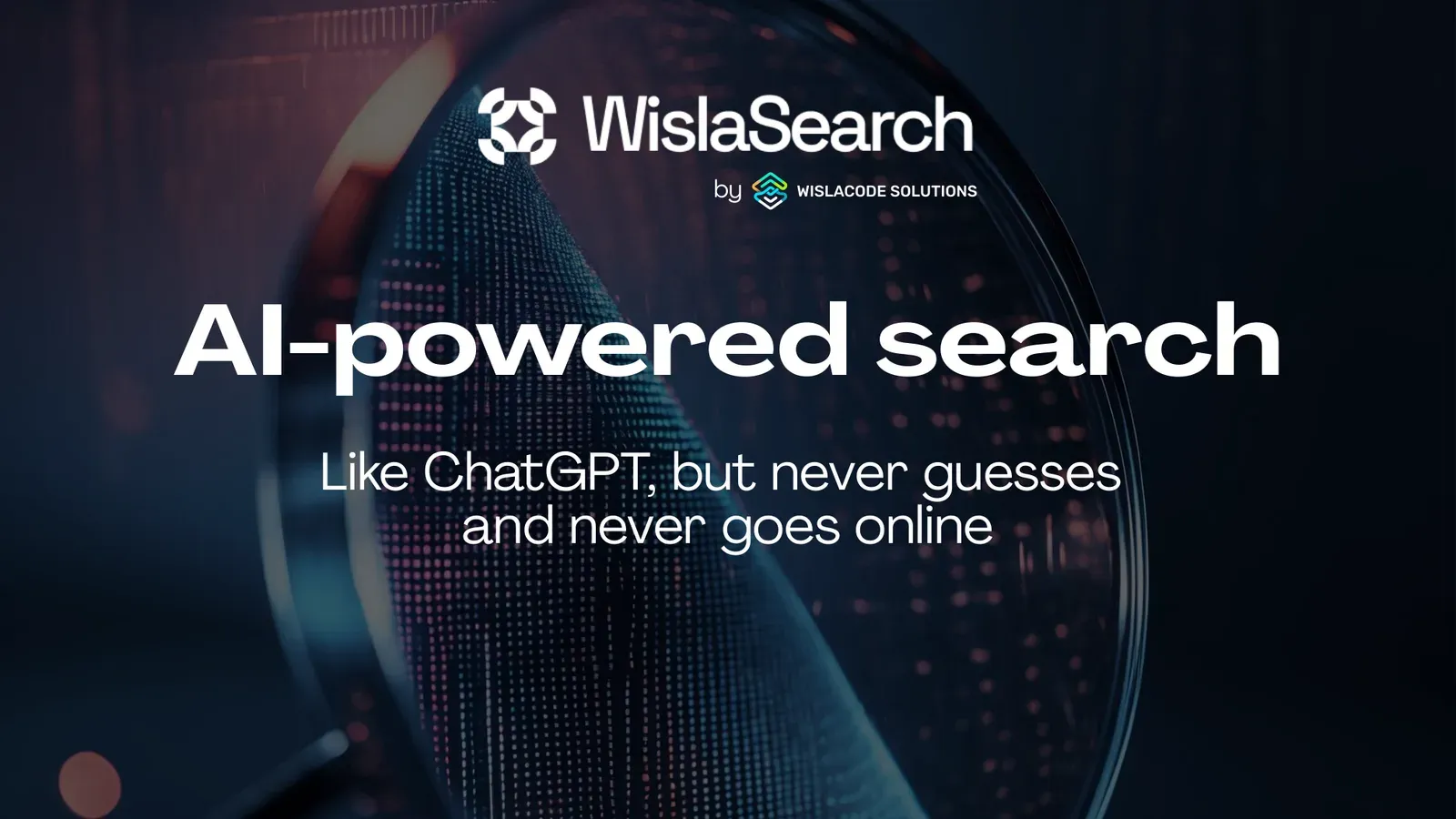
A private, on-premise WislaSearch deployment that turns a logistics operator's scattered operational knowledge into instant, cited answers - without anything leaving their network.
View case
An AI-driven solution that optimises medical sales representative routes and improves field efficiency, using deep learning over visit patterns to predict the best routes.
View case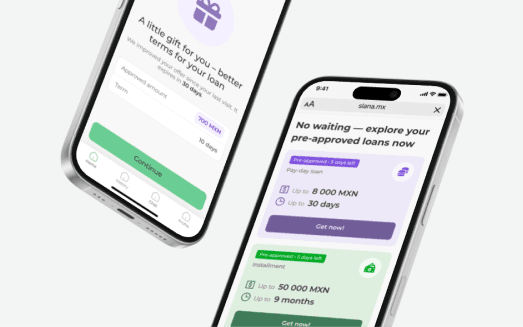
$lana (Monetech), a regulated multi-country consumer credit platform, needed its compliance and data integrations online inside a tight regulatory window. We owned the integration architecture and delivered.
View caseWe've been working with WislaCode since July 2025. What started as enhancing the loyalty program in our GlobalTips guest app grew into a broader partnership where they now handle significant frontend development across our guest app, staff app, and web products.
This was a very task-heavy project, mostly exploration and R&D-driven. However, by the end of WislaCode, we were left with a detailed roadmap consisting of clear milestones - able to be converted into tangible KPIs - and some neat ideas of what actionable are next. Integrating...
We collaborated with WislaCode on a product strategy development project and gave the highest marks for this contractor. The WislaCode team delivered on time and with outstanding quality.
Tell us what you are building
Bring one decision, one dataset or one blocked idea. We will tell you the simplest approach that clears your bar, and scope it with you.