


The European payments sector is changing fast, driven by SEPA Instant Credit Transfers (SCT Inst). By 2025, over 60% of EU financial institutions will support instant SEPA payments, and new rules will likely require every bank and payment service provider to adopt the standard.
SEPA instant payments let you send a euro transfer in under ten seconds, at any time, including weekends and holidays. The limit is €100,000, and the service covers 36 European countries. That is a big step up from traditional SEPA credit transfers, which can take up to a business day to settle.
Why instant payments matter for SMEs
For small and medium-sized businesses, cash flow can be the difference between growth and standing still. SEPA instant payments give SMEs quick access to incoming funds, so they can manage working capital better and react faster to the market.
Key benefits for SMEs
- Better liquidity: quick settlement improves working capital and reduces the need for credit lines.
- Stronger supplier ties: faster payment builds trust and can win better terms.
- A competitive edge: fulfil orders and respond to the market faster than rivals.
- A better customer experience: instant refunds and payments raise satisfaction and loyalty.
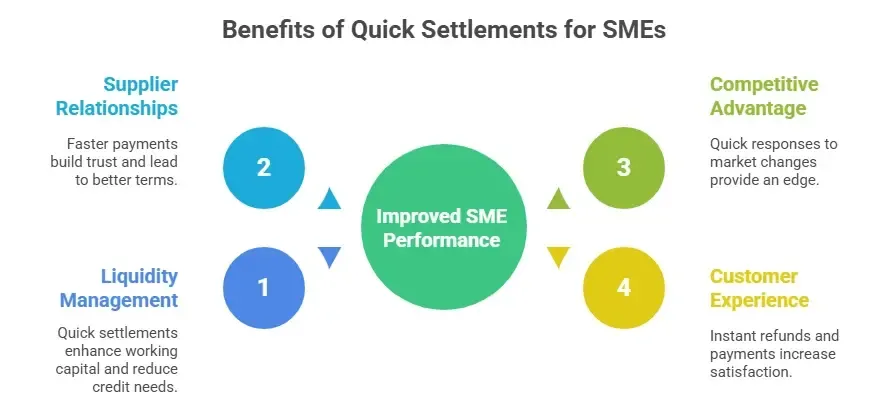
Immediate settlement also helps with suppliers: a business can pay invoices on delivery or negotiate better terms. Customers gain too, with instant refunds and quicker order processing now expected.
How banks benefit from SEPA instant payments
Banks have to meet demand for faster payments and comply with new EU rules. By the end of 2025 they must support sending and receiving SEPA instant payments. This is more than a tech upgrade - it is a move to stay competitive.
Advantages for banks
- Customer retention: instant payments are now a key differentiator in retail and business banking.
- Operational efficiency: automated, real-time processing cuts manual work and cost.
- New revenue: value-added services such as API-based payment initiation and real-time treasury management.
- Compliance: the EU Instant Payments Regulation (IPR) requires all banks and payment service providers to send and receive SEPA instant payments by the end of 2025.
By automating payment processing, banks lower costs and can offer new services like real-time treasury management. Mandatory IBAN name checks and daily sanctions screening add security and cut fraud risk.
SEPA instant payments vs faster payments in the UK
While SEPA instant payments reshape the eurozone, the UK has its own real-time system, Faster Payments. Launched in 2008, it moves money between UK bank accounts in seconds, 24/
Both systems share round-the-clock availability, fast settlement and a focus on liquidity. But SEPA instant payments reach across borders within the euro area, whereas Faster Payments is UK-domestic only. That matters for SMEs and banks working across several European markets, since SEPA instant simplifies cross-border euro transfers and supports the single market.
Key regulatory changes and trends
The European Commission's Instant Payments Regulation, in force from April 2024, requires all eurozone banks to offer instant payments at no extra cost over standard SEPA transfers. By December 2025, all banks must support both sending and receiving instant payments and add IBAN verification to reduce fraud. These changes should drive further adoption and innovation.
Notable trends
- Pricing parity: instant payments must not cost more than standard SEPA credit transfers, so they are open to every business.
- Mandatory IBAN verification: name checks become standard before a payment starts, to reduce fraud.
- Sanctions screening: daily screening of client databases instead of per-transaction checks, cutting false positives and failed payments.
- Direct access for fintechs: payment and e-money institutions connect directly to SEPA, boosting competition and innovation.
Another trend is direct access for fintechs and e-money institutions: connecting straight to SEPA systems and offering instant payments without a sponsor bank. That should raise competition and lead to new, customer-focused solutions.
Challenges and opportunities
The move to instant payments brings challenges. Banks and providers must upgrade infrastructure for real-time processing and higher volumes. Cybersecurity is a concern, because the speed leaves little time for traditional fraud checks, so advanced analytics and machine learning increasingly monitor transactions and flag suspicious activity in real time.
Key challenges
- Infrastructure upgrades: systems must handle 24/
7/ 365 real-time processing and higher volumes. - Cybersecurity: the speed of instant payments needs advanced analytics and AI-driven risk management.
- Interoperability: clean integration across platforms and countries is still a technical hurdle.
Despite the challenges, the benefits for SMEs and banks are real: better cash flow, a better customer experience and room to innovate all make for a more dynamic, resilient European economy.
Few successful projects of WislaCode

The future of instant payments in Europe
SEPA instant payments are set to become the standard for business and consumer transactions across Europe. As adoption grows, limits may rise, and integration with technologies like blockchain and digital identity is likely to speed up.
For SMEs, instant payments mean better cash flow, stronger supplier and customer relationships, and the agility to do well in a fast market. For banks, it is a chance to modernise, innovate and stay central to European payments.
WislaCode develops modern solutions
Effective use of artificial intelligence requires a deep understanding of the entire ecosystem, including trust, security and flexibility.
WislaCode builds mobile and web apps for businesses and financial institutions. Our team delivers end-to-end digital solutions, from secure data storage and backend systems to clear interfaces and payment integrations. We help clients stay ahead with reliable, scalable technology built around their needs.
What are immediate euro transfers and how do they differ from traditional SEPA payments?
Immediate euro transfers enable funds to be sent and received within seconds, regardless of the time or day. Unlike traditional SEPA credit transfers, which may take up to one business day, these instant payments provide near real-time access to funds, greatly improving cash flow for both businesses and individuals.
How do real-time settlement solutions benefit SMEs and banks?
Real-time settlement solutions allow transactions to be completed instantly, reducing the risk of payment delays and improving financial transparency. For SMEs, this means better working capital management, while banks can offer more competitive and efficient services to their clients.
What is on-demand payment processing and why is it important for modern businesses?
On-demand payment processing refers to the ability to initiate and complete payments at any time, without waiting for traditional banking hours. This flexibility is crucial for businesses operating in fast-moving markets, as it supports immediate settlements and enhances customer satisfaction.
How does the pan-European payment infrastructure support instant payments?
The pan-European payment infrastructure connects banks and payment service providers across 36 countries, enabling seamless euro transfers. This unified network ensures that instant payments are accessible to businesses and consumers throughout the EU, supporting cross-border commerce and economic integration.
Why is 24/7 payment availability essential in today’s financial landscape?
With 24/7 payment availability, users can send and receive funds at any time, including weekends and public holidays. This constant access is now expected by both businesses and consumers, helping to streamline operations and improve overall financial agility.
How does IBAN verification for fraud prevention work in instant payment systems?
IBAN verification checks that the account details and recipient’s name match before a payment is processed. This extra layer of security helps prevent fraud and reduces the risk of misdirected payments, which is especially important given the speed of instant transactions.
What does compliance with instant payments regulation mean for banks and payment providers?
Compliance with instant payments regulation requires banks and payment service providers to offer instant euro transfers, implement IBAN verification, and ensure that fees for instant payments are not higher than standard SEPA transfers. Meeting these requirements is essential for operating within the EU’s evolving regulatory framework.
How do cross-border instant payments impact SMEs trading across Europe?
Cross-border instant payments allow SMEs to send and receive funds quickly between different European countries, eliminating delays and currency barriers. This capability supports international growth, strengthens supplier relationships, and enhances competitiveness in the single market.