

I started as an IT person, and we always propose technology. Then I went over to the bank side and understood what nonsense I had been proposing. Sitting there, I thought: what are you talking about? That is not what my head hurts about at all.
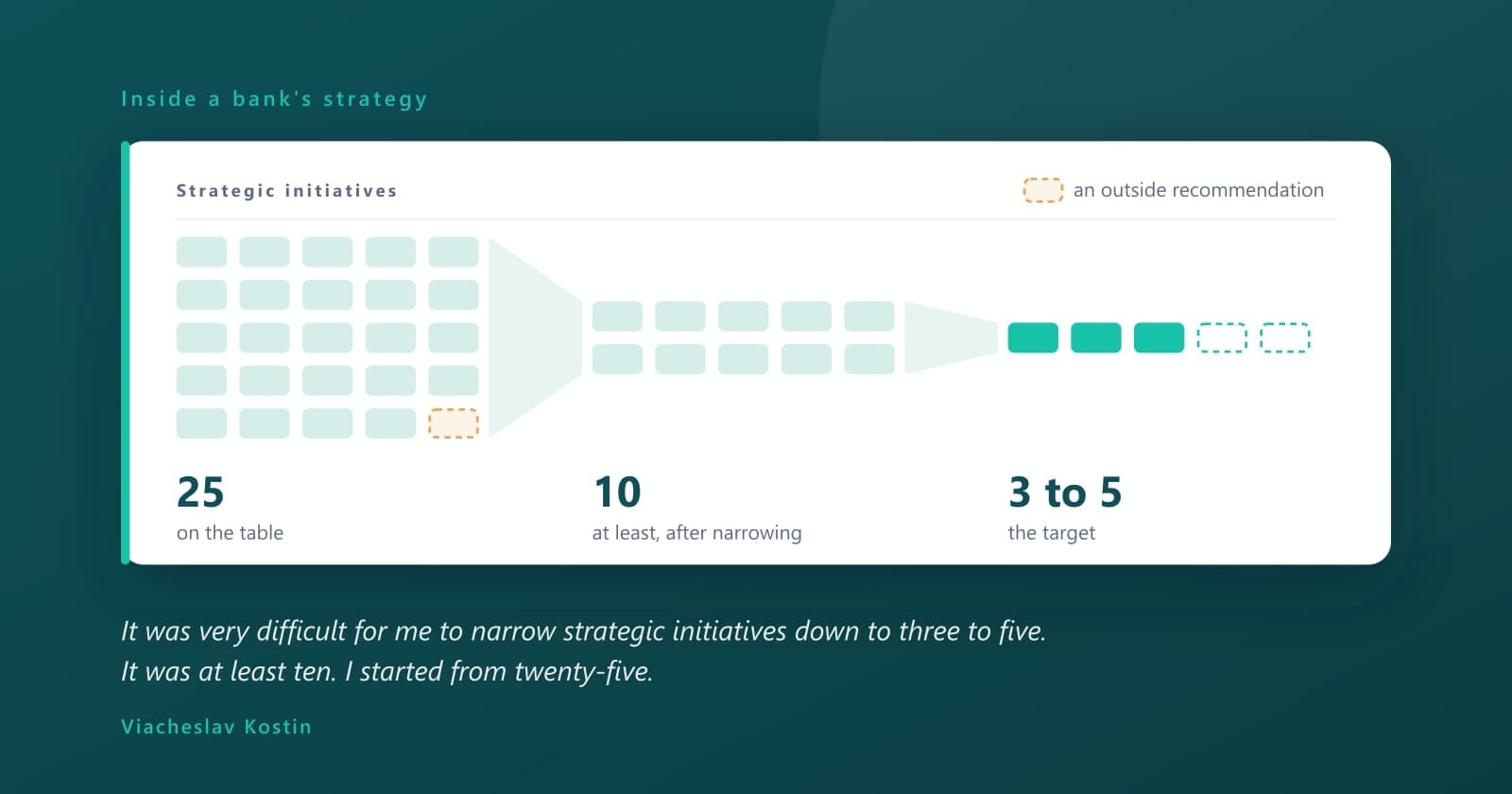
I had been a strategy director in a bank, and it was very difficult for me to narrow strategic initiatives down to three to five. It was at least ten. I started from twenty-five.
An outside recommendation arrives into that funnel and has to beat the twenty-four already in it.
Most of the time it is not politics
The team is loaded with operational work and its own pipeline. The backlog is completely full, most likely with very important tasks that were approved at board level, and there is no getting off them.
So new hypotheses are hard to test. As a rule, to get something approved and into the product backlog, you have to test it, understand the metrics, the business metrics. How customers behave, what the penetration is, what the retention is, maybe how they use it at all or what they say about it, before you defend it and start investing in it.
Read that list again from the position of the person you are asking to champion your recommendation. That is the work you are handing them, before they can even argue for it.
And sometimes it is politics
Say we take the consulting, and we strain, and we do it well. It hurts us, but it is always good. And we put that paper on the desk of a deputy chairman of the board.
Where does that paper go next? He passes it down to the technical director. The technical director says: nobody agreed this with me, and I think differently. And these people who wrote it, are they going to implement it themselves? Then go ahead, please, take my place.
I would have done the same in his place. Someone from outside, not tied to the bank at all, is advising something that puts his competence in question. That is simply a dead end. You will not break through.
So I would try to reach the CTO first, get to know him, and present the whole thing as help to him. Through helping him you can then go up to the leadership. Otherwise he will stall everything, and we will simply have done empty work. We help him, we tell him what we see, he gives his opinion, he says they are fine as they are, and that is it. You end up with two different opinions, and the bank decides which one looks better argued.
There is often nobody to answer you
I suspect there will not be one responsible person on their side. We will have to assemble a whole crowd, and working out who is responsible for each question is going to be difficult. We need a proper project kickoff to understand who owns what, and why they should answer us and disclose that information at all.
There is no documentation. They take no responsibility. You have to keep pushing them, managing the projects, and so on. On a banking software project that is not a complication at the edges. It is the shape of the work.
Design the work so it survives you
This is the part a buyer can act on, and it is worth asking a supplier for by name.
The first stage is discovery, and the important thing is that discovery creates an artefact you can detach. I say this to clients directly: I hope it will not happen, but if you decide to switch to another provider, it is still a useful document. It is not something you throw away.
The output should work in two directions at once. On one side you show it to the regulator. On the other, you pull whatever the service is missing into implementation. And it should be the minimum that is actually sufficient, not the maximum. You need someone who has done it before and knows how little you can describe and still be accepted.
The same test applies to the code. We are completely transparent with our customers. We work in your repository and we submit all the source from day one, so it does not mean you receive everything only at the end.
Buying a discovery you can keep
We scope discovery so the artefact stays useful to you whoever builds the thing afterwards.
What honest timing sounds like
Nobody, and not only a bank, nobody can set a task in enough detail that you can sit down and program it.
You will see an increment every two weeks. But for the first month it is necessary to set everything up, so there is nothing to show in the first month.
Consulting must not run longer than three months. Nobody needs it that long. It is not that we start from the scope and then disappear for years. Whatever we can deliver in three months, we deliver. A long consulting project is always a stillborn product.
From zero to a first live mobile MVP with real clients, with fintechs and banks, is usually six to eight or nine months, depending first of all on how cautious the client is. Five months happened once, with a genuinely fast client. That is rare. And there are clients we carry for a year. That is fine.
A note on the numbers you have been shown
Our industry sells this work on failure statistics, and they do not hold up. The best evidence runs the other way. Flyvbjerg and colleagues, in the Journal of Management Information Systems in 2022, studied 5,392 IT projects completed between 2002 and 2014, measuring cost overrun as actual cost divided by estimated cost. Overruns and underruns were about equally frequent, and the median project came in at 1.0, exactly on budget. Their central finding is stronger than any headline percentage: overruns follow a power law, so in their own words the average cost overrun for IT projects does not exist and cannot be calculated.
Most of this work lands somewhere near plan. A small share goes very badly wrong, and that small share is where the money is. The UK National Audit Office has published the anatomy of both kinds.
You cannot tell in advance which one you are in. So you buy the detachable artefact and the three-month ceiling as insurance against the tail.
Where the failures do cluster once the work starts is a separate question, and we wrote it up separately: core banking transformation fails in the seams, not the ledger.
Planning work inside a bank
If you are scoping a build and want an honest read on sequencing and time, we are happy to look.
Why do banks reject recommendations that are technically correct?
Usually not because of politics. The backlog is already full of board-approved work, and before anyone can defend a new idea internally they have to produce metrics for it: adoption, penetration, retention, evidence of how customers actually use it. An outside recommendation competes against everything already in that funnel. The political version is real too: a paper that arrives over the technical director's head, without his agreement, puts his competence in question and he is right to block it.
What is a detachable discovery artefact?
A discovery output that keeps its value if you never work with that supplier again. It should serve two directions at once: something you can show a regulator, and a list of what your service is missing that you can pull straight into implementation. It should be the minimum that is genuinely sufficient rather than the largest document that can be produced.
How long should a consulting engagement with a bank run?
No longer than three months. Nobody needs it longer than that, and a long consulting project is always a stillborn product. Plan backwards from the ceiling: whatever can be delivered in three months is what gets delivered.
How long does it take to launch a first banking MVP?
From zero to a first live mobile MVP with real clients, working with fintechs and banks, is usually six to eight or nine months, depending most of all on how cautious the client is. Five months has happened once, with a genuinely fast client, and that is rare. In the first month there is nothing to show, because that month goes on setting everything up; after that you should see an increment every two weeks.
Is it true that most bank transformation programmes fail?
Not on the best available evidence. Flyvbjerg and colleagues studied 5,392 IT projects completed between 2002 and 2014 and found overruns and underruns about equally frequent, with the median project coming in at 1.0, exactly on budget. The risk is real, but it sits in the tail rather than in the middle: overruns follow a power law, and in the authors' own words the average cost overrun for IT projects does not exist and cannot be calculated. That is an argument for protecting yourself against the tail, not for assuming failure.