

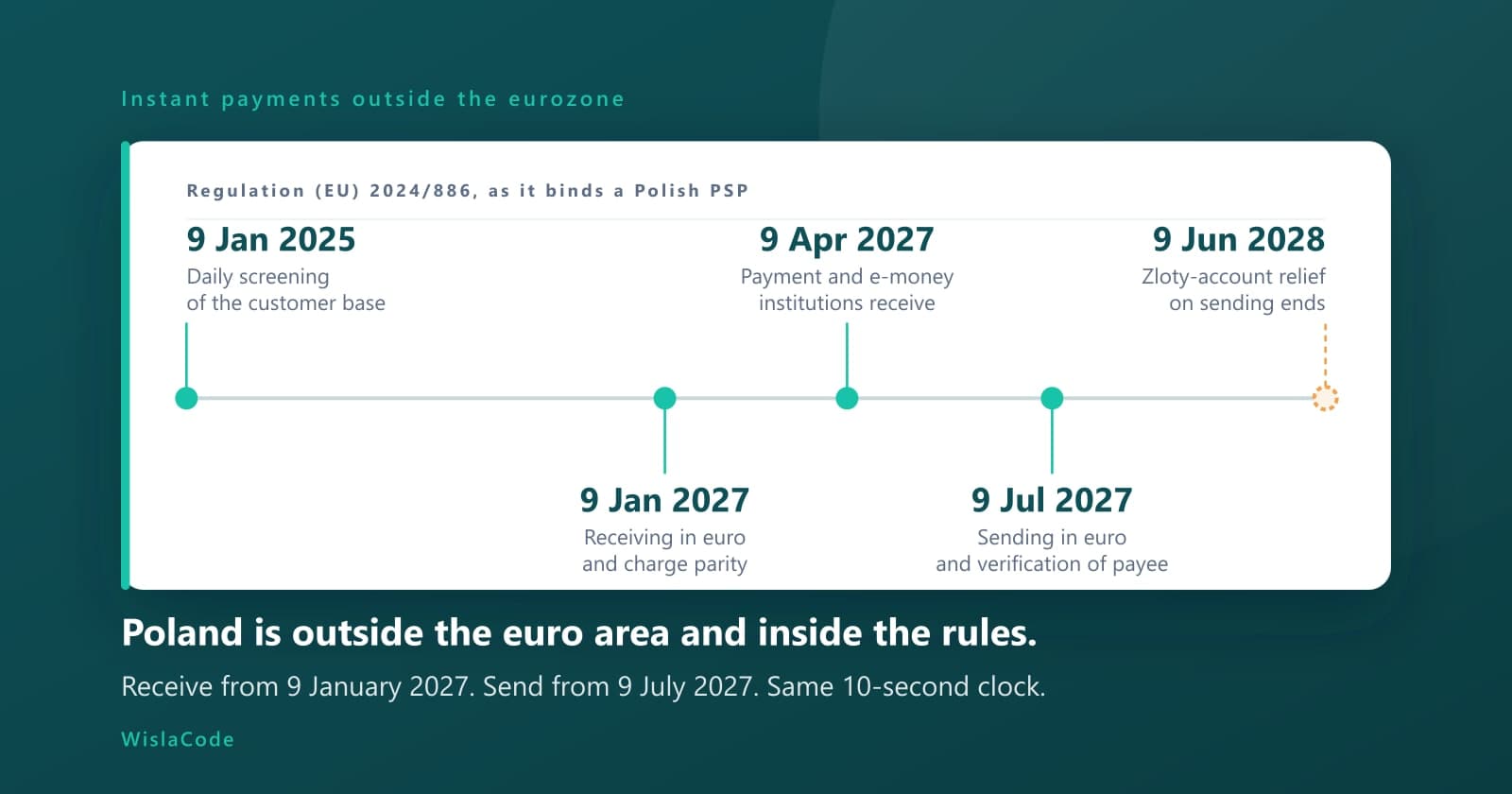
Poland keeps the zloty and the EU instant payments rules still apply in full. Regulation (EU) 2024/
What Regulation (EU) 2024/
The trigger sits in Article 5a(1) of Regulation (EU) No 260/
Article 5a(4)(c) sets the clock. Within 10 seconds of the moment the payer's PSP received the payment order, the payee's PSP makes the funds available on the payee's account and confirms completion. Point (e) puts a second duty on the payer's side, to tell the payer inside those same 10 seconds whether the money arrived, free of charge. Article 5a(5) covers the silence: with no confirmation inside 10 seconds, the payer's PSP immediately restores the account to the state it would have been in without the transaction.
Article 5b(1) caps the price. A charge for sending or receiving an instant credit transfer may not exceed the charge that the same PSP levies for other credit transfers of a corresponding type. For Polish PSPs that rule starts on 9 January 2027, six months ahead of the sending obligation. The Commission's implementation Q&
A second cap sits alongside it, and it is the one Polish pricing teams miss. Article 3(1) of Regulation (EU) 2021/
Verification of payee is the third obligation, and Article 5c(9) puts it on 9 July 2027 for Polish PSPs. The build behind it is a project of its own, covered separately in implementing verification of payee before July 2027.
The fourth obligation applies already. Article 5d requires any PSP offering instant credit transfers in euro to screen its own users against targeted financial restrictive measures immediately after any new listing or amendment, and at least once every calendar day. Paragraph 2 then bars the payer's PSP and the payee's PSP from screening payer or payee again during execution. Article 5d(3) gives one date for everybody, 9 January 2025, and the Commission's Q&
Obligation | Euro area banks | Polish banks | Polish payment and e-money institutions |
|---|---|---|---|
Receiving instant credit transfers in euro | 9 January 2025 | 9 January 2027 | 9 April 2027 |
Sending instant credit transfers in euro | 9 October 2025 | 9 July 2027 | 9 July 2027 |
Charge parity, Article 5b | 9 January 2025 | 9 January 2027 | 9 January 2027 |
Verification of payee, Article 5c | 9 October 2025 | 9 July 2027 | 9 July 2027 |
Daily screening of users, Article 5d | 9 January 2025 | 9 January 2025 | 9 January 2025 |
Who the 2027 dates bind, and who gets longer
Payment institutions and e-money institutions are inside the regulation on a ramp of their own. Article 5a(8) gives those located outside the euro area 9 April 2027 for receiving and 9 July 2027 for sending; in the euro area both obligations fall on 9 April 2027. Access is the reason for the gap. Until 2024 those firms could not participate in a designated payment system, because Directive 98/
Location decides the date. The Commission's Q&
Two reliefs exist for non-euro area PSPs, and both are narrower than they look. Article 5a(8) lets a Polish PSP wait until 9 June 2028 before sending euro instant credit transfers from zloty accounts, and only during the hours when it neither sends nor receives ordinary euro credit transfers for those accounts. Receiving stays outside the relief. Article 5a(2) is the second: with prior permission from its competent authority, granted on that authority's assessment of the PSP's access to euro liquidity, a Polish PSP need not send euro instant credit transfers above a per-transaction limit from zloty accounts during those same hours. The authority sets that limit, it cannot fall below EUR 25,000, and the permission runs for a year at a time.
Enforcement is now Polish law. The Act of 23 January 2026 puts supervision of Articles 5a to 5d with the KNF and lets it fine a provider up to 10% of its net income from payment services, and a manager responsible for the breach up to PLN 21,500,000. Those provisions enter into force on 9 January 2027, the same day as the receiving obligation. A reachability failure caused by announced planned maintenance or by planned downtime of the whole scheme is carved out under Article 11(1c).
Putting an always-on layer in front of a batch core?
Our free practitioner guide sets out the orchestration-layer pattern we use for core banking integration: one middle-tier orchestrator, one wrapper per legacy system, collect-then-distribute for long flows, with two anonymised field examples and a build checklist.
What Poland already runs, and what is still missing
Poland has run instant payments in zloty for years. KIR's Express Elixir is available 24 hours a day, 7 days a week and on public holidays, with more than 25 commercial banks and around 450 cooperative banks on it. None of it counts towards the regulation, whose scope is transactions denominated in euro.
The euro leg is newer and much thinner. Euro Express Elixir has been in production since July 2023, carries SCT Inst messages, settles on TIPS and puts funds with the payee inside 10 seconds. KIR lists its participants as Erste Bank Polska, BNP Paribas Bank Polska, mBank's Slovak branch and PKO Bank Polski with four of its foreign branches.
The size of the gap is in the ECB's own numbers. Its list of TIPS participants and reachable parties, in the version dated 1 September 2026, carries 11 BICs registered in Poland. The EPC's April 2026 adherence figures point the same way: 2,734 euro area PSPs in the SCT Inst scheme against 83 outside it, and 2,743 against 25 for verification of payee. Every Polish PSP that offers euro credit transfers has to be reachable for euro instant credit transfers by 9 January 2027 (payment and e-money institutions by 9 April 2027), and has to offer verification of payee by 9 July 2027.
Two settlement mechanisms are open, with a choice of connection inside each. A PSP can hold a TIPS dedicated cash account or be a reachable party on somebody else's, and it can send its own messages or hand that to an instructing party; KIR is one. RT1, run by EBA CLEARING, is the other, with 94 SCT Inst participants, and it settles in central bank funds with a connection to TIPS through a dedicated cash account or a technical account. The choice is a payment orchestration decision as much as a treasury one, because it sets where retries, timeouts and reconciliation live.
What breaks first when a Polish bank builds this
Three items on that list behave differently when the customer holds zloty, and they are the ones that decide build order.
The first is foreign exchange inside the clock. Article 5a(3)(c) says that for a payment order from an account not denominated in euro, the time of receipt is the moment the amount has been converted into euro, and the conversion has to follow immediately after the payer places the order. A quoted rate therefore has to exist at 03:00 on a Sunday, against a zloty balance, at a margin the treasury will accept with nobody watching. Receiving makes that true from 9 January 2027, whatever the sending relief allows: a euro payment arriving for a zloty account has to be converted inside the 10 seconds, and the Commission's Q&
The second is euro liquidity. TIPS runs 24/
The third is screening, and it inverts the control. Article 5d makes the daily pass over the user base the sanctions control, which means the per-transaction check against targeted financial restrictive measures comes out of the payment path. A team that leaves it in is slower and outside the rules at the same time. Fraud scoring, transaction monitoring and restrictive measures that are not targeted financial ones all stay in the flow, and all of them now answer inside a budget that the confirmation message closes.
Then the plumbing that rarely reaches a budget line. Bulk file intake has to run 24 hours a day, and the Commission has confirmed that both receipt and unpacking are covered, so a file arriving at 22:00 on a Sunday starts a 10-second clock per item as it is unpacked. Corporate cut-off windows disappear with it. User limits become a product feature, because Article 5a(6) gives every user the right to set a maximum per day or per transaction and to change it before placing an order, and the scheme's own EUR 100,000 ceiling went with the 2025 SCT Inst rulebook on 5 October 2025.
The order we use on work of this shape: settle the FX and liquidity answers first, then prove an always-on path for a single payment end to end, then move screening out of the path, then the bulk channel, then verification of payee against the directory. Legacy core modernisation belongs in the same programme on a parallel track. Where the core cannot be touched in time, an integration layer in front of it carries the 24/
Working to the January and July 2027 dates?
WislaCode builds regulated banking and payment software where the architecture has to answer to a supervisor: 24/7 processing, real-time settlement paths, screening that runs where the rules now put it, and the integration work underneath all of it.
Does the EU Instant Payments Regulation apply in Poland even though Poland is outside the euro area?
Yes. Regulation (EU) 2024/886 amends the SEPA Regulation for every EU member state, and it covers credit transfers denominated in euro wherever the PSP is located in the Union. A Polish PSP that offers its customers euro credit transfers has to offer euro instant credit transfers as well, on a later calendar than the euro area.
What are the exact 2027 deadlines for Polish PSPs?
Article 5a(8) requires Polish banks to receive instant credit transfers in euro from 9 January 2027 and to send them from 9 July 2027. Polish payment institutions and e-money institutions receive from 9 April 2027 and send from 9 July 2027. The charge parity rule in Article 5b starts on 9 January 2027 and verification of payee under Article 5c on 9 July 2027.
Can a Polish bank charge more for an instant euro transfer than for a standard one?
No. Article 5b(1) says a charge for an instant credit transfer may not exceed the charge for other credit transfers of a corresponding type, and that applies to Polish PSPs from 9 January 2027. Article 3(1) of Regulation (EU) 2021/1230 applies in parallel, tying the charge for a cross-border euro payment to the charge for a corresponding national payment in zloty. Currency conversion charges sit outside both rules.
Does Express Elixir count towards compliance with the regulation?
No. Express Elixir clears instant transfers in zloty, and the SEPA Regulation as amended covers transactions denominated in euro. Polish PSPs need a separate euro capability reachable through TIPS or RT1, which KIR offers through Euro Express Elixir and other providers offer through a direct or indirect connection.
What happens if a Polish PSP misses the 2027 deadlines?
The Act of 23 January 2026 gives the KNF supervision over Articles 5a to 5d of the SEPA Regulation and the power to fine a provider up to 10% of its net income from payment services, with up to PLN 21,500,000 for a manager responsible for the breach. Those powers enter into force on 9 January 2027. A reachability failure caused by planned maintenance announced in advance is excluded under Article 11(1c) of the regulation.
How long does a bank have to complete an instant credit transfer in euro?
Ten seconds, measured from the time the payer's PSP receives the payment order, under Article 5a(4)(c). Inside that window the payee's PSP makes the funds available and confirms completion, and the payer's PSP tells the payer the outcome. For an order from a zloty account the clock starts at the moment of conversion into euro, which Article 5a(3)(c) requires to happen immediately after the order is placed.