
Payment orchestration
Multiple payment orchestration for platforms running more than one acquirer or PSP: routing, cascading, failover and a single reconciliation view across every provider.
Results from work we have shipped
Shortlisting a software development partner?
The questions to ask in an RFP, three warning signs a vendor may not deliver, and a scoring matrix to compare contractors objectively.
What an orchestration layer gives you
Route each payment by method, currency, market, card scheme, cost or approval rate - as a rule set your team can change, not a deployment.
A declined or failed authorisation retried at a second provider, with the rules that decide when a retry is legitimate and when it is just a second decline.
A provider incident becomes degraded routing rather than an outage, because the traffic has somewhere to go and the platform knows when to send it there.
A token vault the platform owns, so card-on-file survives a provider change and a customer is not asked to re-enter a card because you switched acquirer.
Every provider's settlement file normalised into one model, so finance reconciles once instead of once per provider.
Approval rates, costs and failures compared across providers on the same definitions - the data you need to route on economics rather than on belief.
A new acquirer becomes an adapter behind an interface you already have, instead of a second payment integration through the product.
Running more than one acquirer, or about to?
Send us the providers and the markets. We will tell you whether orchestration is worth it yet, and what it would take.
How we deliver payment orchestration?
The same delivery discipline on every engagement - from the first map to a handover your team runs.
Orchestration is not free. We look at your volumes, providers and failure rates and tell you plainly whether it pays for itself yet - a single provider done well beats an orchestration layer nobody needed.
One internal payment contract, adapters behind it, routing as a rule set with the tokens and the reconciliation model owned by you rather than by whichever provider you started with.
Providers move behind the interface one at a time, with traffic shifted gradually and the old path live until the new one has proven itself on real money.
Routing rules, dashboards, reconciliation and runbooks your team operates. If you need us to change a route, we have built the wrong thing.
What shapes the work
A platform that grows past its first market or its first volume tier runs into the same wall twice. The first time it is availability: the provider has an incident, and every payment fails because there is nowhere else to send it. The second time it is economics: the provider's pricing or approval rate is no longer competitive in a market, and the cost of switching is a rewrite of the checkout.
Payment orchestration is the answer to both. It is a layer that sits above the providers, holds the payment logic itself, and treats each acquirer or PSP as an interchangeable route rather than as the platform's payment system.
It is not a product you buy so much as a boundary you design. Done well, adding the next provider is configuration. Done badly, it is a second integration wearing an abstraction.
The interesting decisions in orchestration are commercial. Which provider gets this card scheme in this market. When a decline is worth retrying elsewhere and when the retry is just a second cost. Whether an extra basis point of approval rate justifies a more expensive route.
Those decisions change far more often than software does, and they belong to the people who own the payment economics - not to a release cycle. So we build routing as an explicit, inspectable rule set with a change history, and we make the effect of a rule measurable before it is switched on.
The same principle applies on the billing side, where pricing policy has an identical habit of ending up buried in code. We have written about that at billing software development.
A cascade - retrying a failed payment at a second provider - is the most attractive feature of orchestration and the easiest one to get wrong. Retry the wrong declines and you pay twice for a payment that was never going to succeed, annoy the issuer, and in some scheme rules invite a penalty.
The discipline is in the decline codes. A soft decline, a technical failure or a provider timeout is worth another route. A hard decline - stolen card, closed account, do not honour - is a definitive answer and retrying it is noise that costs money.
So we build the cascade around the response taxonomy, with per-scheme retry rules, an idempotency model that guarantees one payment cannot be captured twice across two providers, and reporting that shows what the cascade actually recovered against what it cost.
Most platforms discover their real lock-in at the moment they try to leave a provider. The integration is replaceable in weeks; the stored cards are not. If card-on-file lives in the provider's vault, switching means either a migration the provider has to agree to, or asking every customer to re-enter their card.
If you intend to run more than one provider, the vault has to be a decision rather than a default. That can mean network tokenisation, a provider-independent vault, or a negotiated migration path agreed before you sign - but it has to be decided while you still have leverage.
We design the vault as a narrow, isolated service with its own access control and audit trail, so the freedom to route does not come at the cost of spreading card data through the platform. The PCI DSS considerations are the same ones we describe on payment gateway integration.
The drivers are the number of providers and methods in scope, whether tokens have to migrate, whether cascading and dynamic routing are in scope or only failover, and how much of your existing payment logic is currently welded to one provider's SDK.
The last one is usually the real driver, and it is the one nobody scopes. Extracting payment logic out of a checkout that was written against a single provider is the bulk of the work; the second provider is comparatively easy once the boundary exists.
We will tell you on the first call whether you are ready for orchestration or whether the honest answer is to do the first integration properly and revisit this in a year.
Working with WislaCode Solutions has been a great experience! We needed an Android SDK developed under a tight timeline, and their team delivered a flexible, user-friendly solution that integrated seamlessly into our ecosystem. Their transparent approach, proactive communication, and commitment to quality made the collaboration smooth...
What is included in an orchestration engagement
An orchestration engagement ends with the routing controls in your hands, not ours:
One internal payment contract, with each provider behind an adapter.
A routing rule set your team can read, change and measure, with a change history.
Cascading and retry rules built on the decline taxonomy, with cross-provider idempotency guaranteed.
Failover behaviour proven against a provider outage, not assumed.
A token strategy decided deliberately, with the vault isolated and audited.
Normalised settlement and one reconciliation view across every provider.
Comparable approval-rate and cost reporting, dashboards, runbooks and a documented handover.
When is payment orchestration worth building?
When at least one of three things is true: a provider outage would stop your revenue and you have no second route; your volumes or markets have grown to where routing on cost or approval rate is worth real money; or you need to add or swap a provider and the checkout makes that a rewrite. Below that, a single integration done properly is the better investment, and we will tell you so on the first call rather than sell you a layer you do not need yet.
Should we build orchestration or buy an orchestration platform?
Both are legitimate, and the answer turns on how much your routing logic is a differentiator and how much lock-in you are willing to trade for speed. A bought platform moves the single point of failure rather than removing it, and puts your tokens somewhere new. We are happy to integrate one for you or to build the layer inside your platform - what we will not do is pretend the trade-off does not exist.
Can we keep our existing provider?
Yes. Orchestration is not a reason to leave a provider you are happy with - it is what lets you keep them while stopping them from being your only option. The usual shape is that your current provider becomes the primary route behind the new interface, and a second one is added for failover or for a market where the economics are better.
How should a bank assess a vendor's experience with legacy payment systems?
Test them on the parts that never appear in a proposal. Ask how they would move card-on-file tokens out of a provider's vault, and listen for whether they know that needs the provider's cooperation. Ask what they do about a legacy system that cannot receive a webhook. Ask how they would prove a routing change did not alter approval rates - the answer should involve running both routes in parallel on real traffic, not a test plan. Vendors who have only built greenfield integrations answer these in the abstract, and it is audible.
Does an orchestration layer change our regulatory position?
Usually not, if it is built as a technical layer and never touches the funds. Article 3(j) of PSD2, Directive (EU) 2015/2366, excludes technical service providers that support payment services without at any time entering into possession of the funds. What does change is your ICT dependency picture: the layer becomes an asset supporting a critical function, so it sits inside the DORA regime, Regulation (EU) 2022/2554, with the third-party requirements in Articles 28 to 30 applying to whoever builds and runs it. Responsibility for authentication stays with the payment service provider either way.
How is legacy payment architecture modernised without a feature freeze?
By putting the new interface in front of the old path rather than replacing it. The existing provider becomes the first route behind the internal contract, and nothing about it changes on day one, which is what makes the first step safe. Traffic then moves in slices - one method, one market, one merchant segment - with the old route still open behind each. Feature work carries on against the new interface throughout, which is the point: a freeze is what happens when a migration is a single event instead of a sequence.
Can a first orchestration release land on a fixed date?
Yes, if the first release is failover and not routing. Putting your current provider behind an internal interface with a second one for failover is bounded work with a definable acceptance test, and it removes the single point of failure that usually triggers the project in the first place. Dates slip when cascading and dynamic routing are in that first release, because those depend on your own decline data, which nobody has analysed yet. So we scope the layer first and the commercial rules second, and the fixed date covers the part that can be fixed.
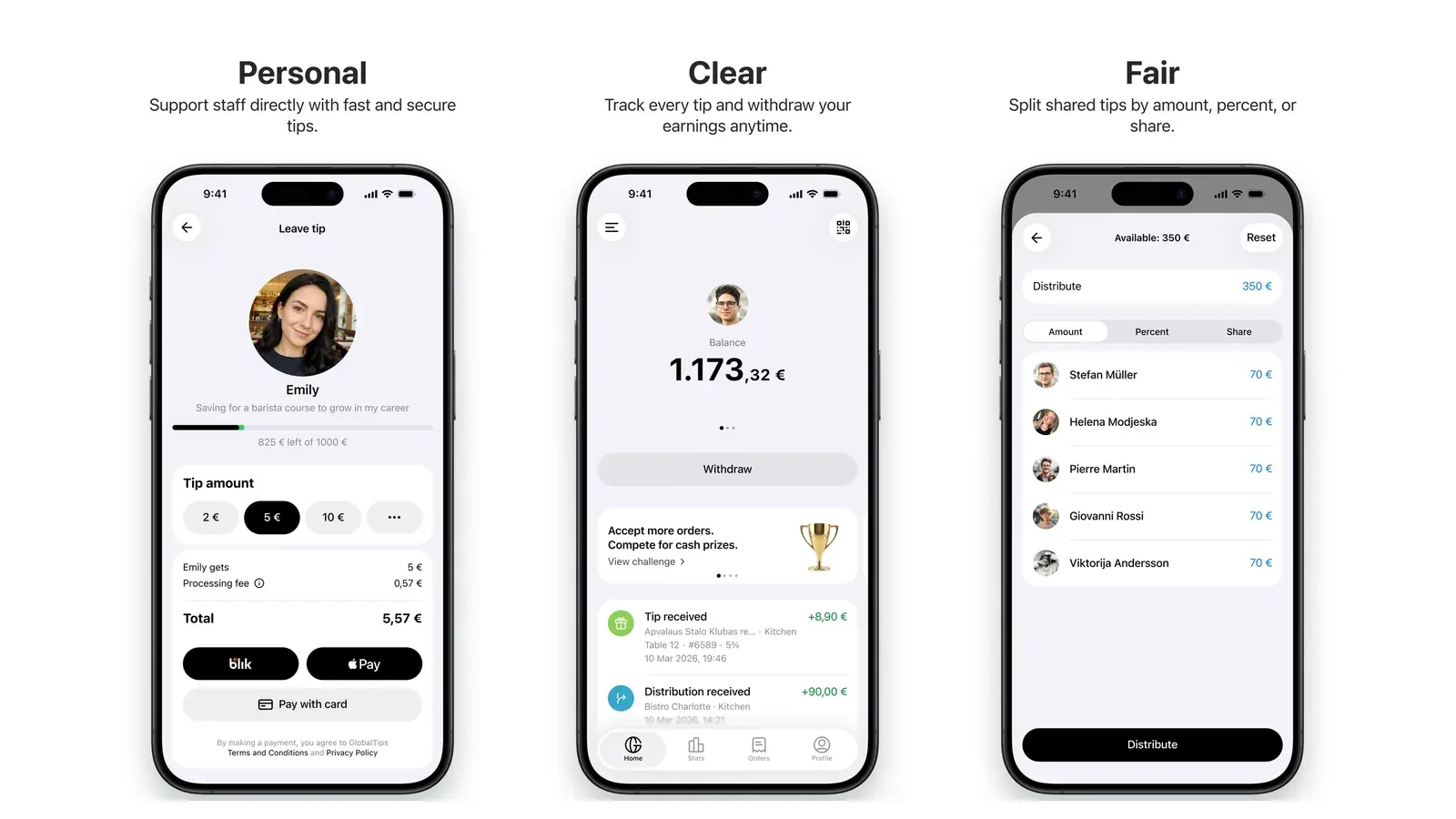
GlobalTips called us in for one feature in their guest app. After 14 monthly cycles, we now build across their guest app, staff app and web products, and BLIK carries about 15% of their payments in Poland.
View case
With Taal Healthtech, we reshaped not just the routing algorithm but how field teams operate: who to visit, in what sequence, and how to spend the day for maximum impact.
View case
An AI-driven solution that optimises medical sales representative routes and improves field efficiency, using deep learning over visit patterns to predict the best routes.
View caseWe've been working with WislaCode since July 2025. What started as enhancing the loyalty program in our GlobalTips guest app grew into a broader partnership where they now handle significant frontend development across our guest app, staff app, and web products.
This was a very task-heavy project, mostly exploration and R&D-driven. However, by the end of WislaCode, we were left with a detailed roadmap consisting of clear milestones - able to be converted into tangible KPIs - and some neat ideas of what actionable are next. Integrating...
We collaborated with WislaCode on a product strategy development project and gave the highest marks for this contractor. The WislaCode team delivered on time and with outstanding quality.
Payments tied to one provider?
Talk to the engineers who would build the layer - routing, cascading, tokens and what it costs to be free.