

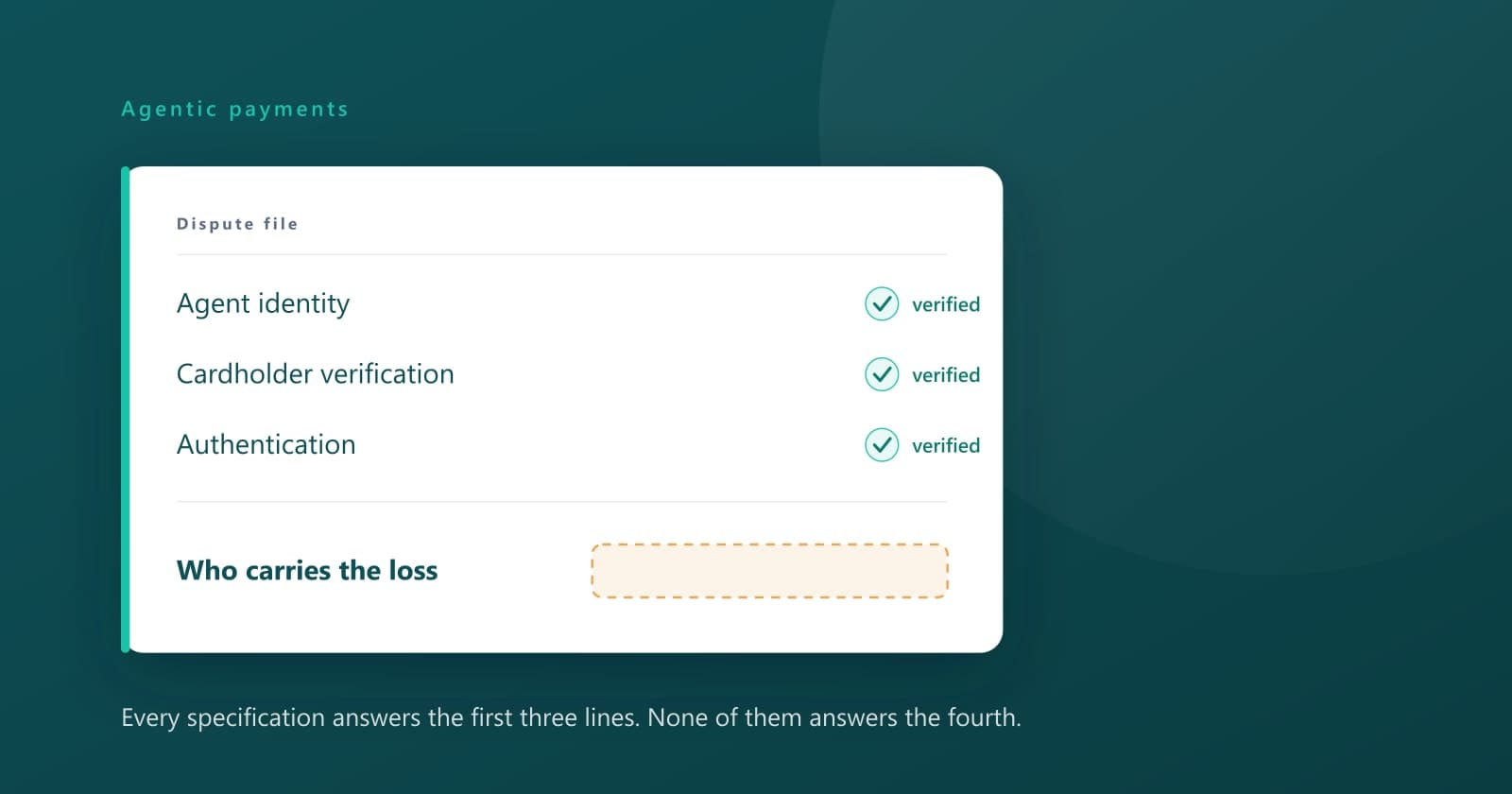
A payment agent is easy to authorise and hard to unwind.
The specifications published this year answer the first half well. Google's AP2 signs the customer's intent as a verifiable credential. Visa carries a verified agent identity into the authorisation message. Mastercard's Agent Pay steps up to a passkey. All three answer the same question: was this agent allowed to pay.
Then the purchase turns out to be wrong. The mandate was valid, the agent was exactly who it claimed to be, and the customer wants their money back. That question lands on a bank's dispute desk, and the documents that were so precise about authorisation go quiet.
What a dispute desk actually looks at
When a customer says they don't recognise a transaction, the bank's disputes team works through a short list. Where the transaction happened. Which merchant took it. How the payment was confirmed. The strongest single item on that list is whether the customer authenticated themselves, and 3-D Secure is the usual proof of it. Where the bank cannot see that, and cannot see any sign that the customer passed their card details to somebody else, the money goes back to the customer and the argument starts between the banks.
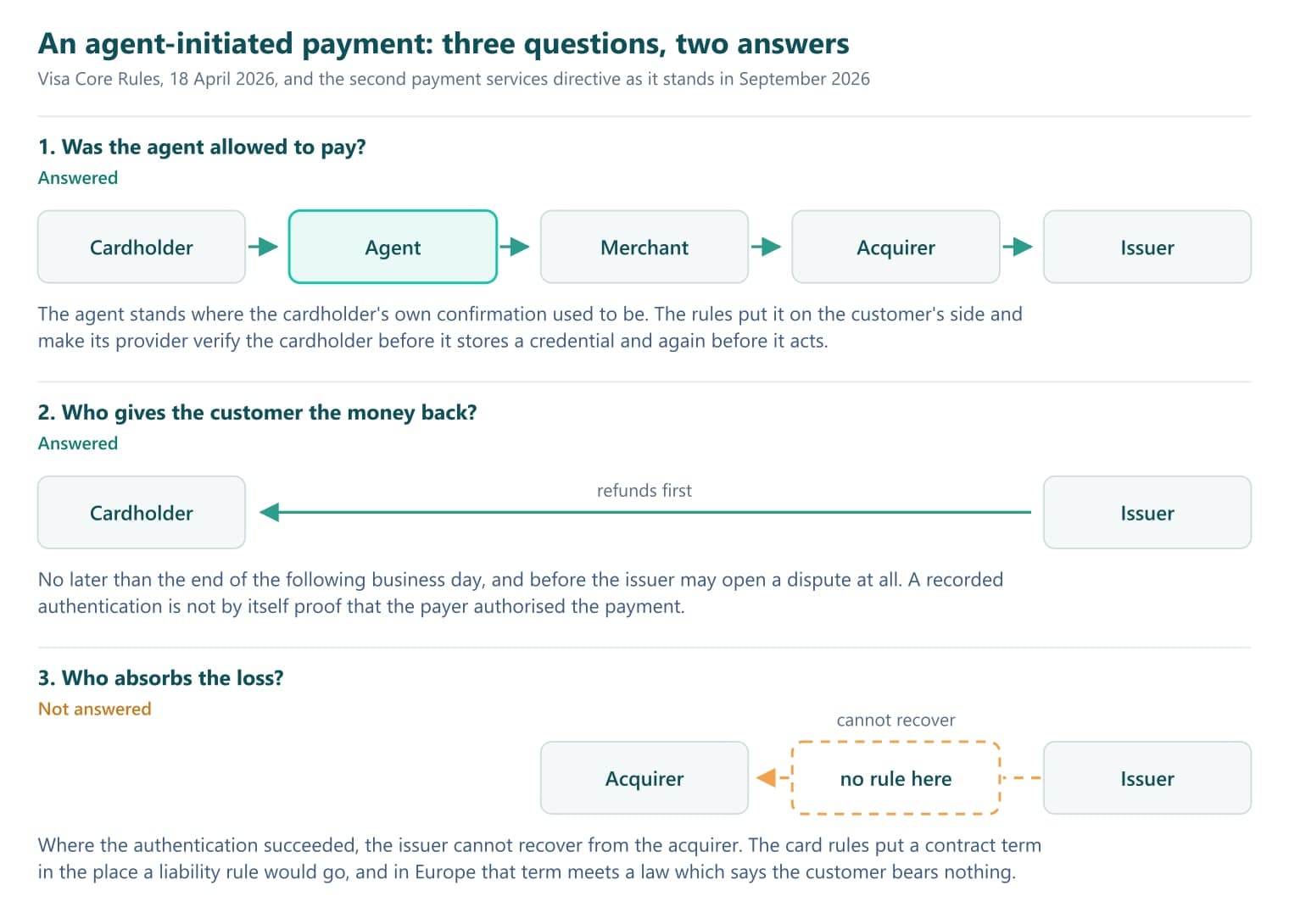
In Europe "goes back" understates it. Article 73(1) of PSD2 requires the payer's provider to refund an unauthorised transaction immediately, and no later than the end of the following business day, with one narrow exception where the provider has reasonable grounds to suspect fraud and reports them in writing to the national authority. Visa's own rulebook puts the steps in the same order: rule 1.10.1.1 requires the issuer to credit the cardholder before it initiates a dispute at all. The refund comes first. Who ends up paying for it is worked out afterwards, when the issuer returns the transaction to the acquirer and the scheme rules on liability between the two of them.
Where 3-D Secure stops
A successful authentication closes the fraud route between the banks. Under Visa's dispute rules a fraud dispute is invalid where the transaction ran with electronic commerce indicator 5, the issuer answered the authentication request with a confirmation, and the authentication value was present in the authorisation. The issuer cannot recover from the acquirer at all.
The bank's obligation to its own customer runs on different rules, and in Europe the law is explicit about it. Article 72(2) of PSD2 says that the recorded use of a payment instrument is in itself not necessarily sufficient to prove that the payer authorised the transaction. Article 74(2) goes further: where the payer's provider did not require strong customer authentication, the payer bears no loss at all unless they acted fraudulently.
Read those together and a bank can be barred from recovering the money and still be obliged to hand it back, which is the position an agent walks into.
The rules already know what an agent is
This is the part most of the commentary has missed. The Visa Core Rules of 18 April 2026 added a section on agentic platforms. It defines an agentic transaction as an electronic commerce transaction undertaken on behalf of a cardholder, completed without direct interaction between the cardholder and the merchant, and it states that the initiators of those transactions are not merchants. The agent sits on the customer's side of the transaction.
The obligations follow from that. Before it acts, the provider has to obtain the cardholder's acknowledgement that they are responsible for what the agent does, and it has to verify the cardholder's identity before it stores a credential and again before it acts on an instruction. At the moment the payment instructions are presented, the wallet has to verify the cardholder through an approved device method.
That is a reasonable answer to the authorisation question, and it is the answer I would have argued for. Agentic payments should not get their own rail. The existing processes are tuned, and a second route means a second copy of everything that has to be secured and reconciled. What genuinely changes is that not every credential can be checked by a person inside the bank any more, so the verification has to sit in the platform and the escalation to a human has to be strict.
Before your agentic API meets a real dispute
We build and integrate payment and identity flows for banks and lenders, and the dispute path is part of the design rather than an afterthought. Bring us the flow you are planning and we will walk it to the point where the money comes back.
And then they stop
Open the dispute chapter of the same rulebook and the agent almost disappears. The word occurs twice in the entire chapter, both times only as a login identifier that a merchant may submit as evidence. There is no dispute condition for an agent-initiated purchase, no entry making such a dispute invalid, and no clause allocating the loss.
The European side is emptier. The technical standards on strong customer authentication, Delegated Regulation 2018/
So the schemes have put a contract term where a liability rule would normally go. A cardholder acknowledges responsibility for what their agent does. In Europe that acknowledgement runs straight into Article 74(2), which is mandatory law and doesn't care what the parties agreed: no strong customer authentication, no loss for the customer.
No published document answers which of the two wins. Put that question to your own legal and risk people before an agentic API goes anywhere near production, because the answer decides whose balance sheet absorbs the first wave of bad purchases.
None of this is an argument for waiting
Agentic payments are coming whether or not any particular bank is ready, and they move more than the payment itself. Transaction flow changes. Volumes change. The risk models, the fraud monitoring and the onboarding models all have to be re-fitted to a payer who is sometimes a piece of software. A bank that opens an agentic API early, even for small amounts, also buys something that is hard to buy any other way, which is customers seeing their own bank on the front edge instead of two years behind it.
What I would build first is the harness rather than the feature. Strong guardrails on the bank's side. A strict path that escalates to a human the moment something looks wrong or cannot be verified. And a dispute process that already knows what an agent-initiated transaction looks like before the first one arrives, because the alternative is learning that on live money.
The part that decides whether any of it holds
One more thing, from having shipped new confirmation methods inside banks. Integration is rarely what fails. Adoption is what fails. Moving a prompt from the middle of the screen to the top is already friction for a customer. A method that switches screens on a phone costs more than that. A method the customer has to go and enable costs more again, and some customers simply don't have the hardware for it. Every one of those comes out of transaction volume, and volume is the thing the whole exercise exists to protect. Without a good experience you don't keep the volume, and the method the customer never completes is the one the bank paid to build.
Mastercard's chargeback guide sits behind a login, so everything above is Visa's public rulebook and EU law as it stands in September 2026. PSD3 and the payment services regulation are still proposals, so these article numbers are the current ones and will move.
Agentic commerce will be argued about on the authorisation side for another year, because that is the half with specifications behind it. The dispute path has no specification yet, and it is where the cost of getting this wrong actually shows up.
Work the dispute path before it works you
If you are scoping an agentic payment flow, the useful question is not whether the agent can pay. It is what your desk does on the day one of those payments is disputed. We can sit that session with your payments and risk people.
Who pays when an AI agent makes a purchase the customer disputes?
No published rule answers it yet. The Visa Core Rules of 18 April 2026 define the agentic transaction and set out what the agent's provider must do before it acts, but the dispute chapter of the same rulebook carries no dispute condition for an agent-initiated purchase and no clause allocating the loss. In practice the issuer refunds the cardholder first and the question of who absorbs it is argued afterwards.
Does a successful 3-D Secure authentication protect the bank?
It protects the bank against the acquirer, not against its own customer. Under Visa's dispute rules a fraud dispute is invalid where the transaction ran with electronic commerce indicator 5, the issuer confirmed the authentication request and the authentication value was present in the authorisation. Article 72(2) of PSD2 then says separately that the recorded use of a payment instrument is in itself not necessarily sufficient to prove the payer authorised the transaction. A bank can be barred from recovering the money and still owe the refund.
How quickly must a European bank refund an unauthorised card payment?
Article 73(1) of PSD2 requires the payer's provider to refund an unauthorised transaction immediately, and in any event no later than the end of the following business day. The one exception is where the provider has reasonable grounds to suspect fraud and reports those grounds in writing to the national authority. Visa's own rule 1.10.1.1 puts the credit to the cardholder before the issuer may initiate a dispute at all.
Do the EU strong customer authentication rules cover payment agents?
Not by name. Delegated Regulation (EU) 2018/389, the technical standards on strong customer authentication, contains no reference to an agent, to autonomy or to a merchant-initiated transaction, and the EBA opinions on strong customer authentication carry none either. The nearest test is an EBA question and answer from 2019 holding that card transactions imply an action of the payer, written about recurring mandates years before agent-initiated buying existed.
What does the Visa Core Rules section on agentic platforms require?
It treats the agent as sitting on the cardholder's side: an agentic transaction is an electronic commerce transaction undertaken on behalf of a cardholder without direct interaction between the cardholder and the merchant, and the initiators of those transactions are not merchants. The provider must obtain the cardholder's acknowledgement of responsibility for the agent's actions, verify the cardholder's identity before storing a credential and again before acting on an instruction, and verify the cardholder through an approved device method when the payment instructions are presented.
Should a bank build a separate rail for agentic payments?
There is no good reason to. The existing authorisation and settlement processes are tuned, and a second route duplicates everything that has to be secured, monitored and reconciled. What does have to change is the verification: fewer credentials can be checked by a person inside the bank, so that check moves into the platform and the escalation to a human has to be strict.