

Enterprise finance is changing fast. Desktop portals and manual processes are losing ground, and corporate mobile banking is leading the shift. Businesses want to manage finances on the move, with instant access to data and the tools to decide, wherever they are.
Mobile banking for enterprises is more than convenience. It gives real-time visibility, tighter security and faster decisions. The move to mobile-first comes from a need for speed and clear financial operations: executives, finance teams and treasury experts need to track cash flow, approve payments and manage risk from their devices.
Corporate mobile banking: the new standard
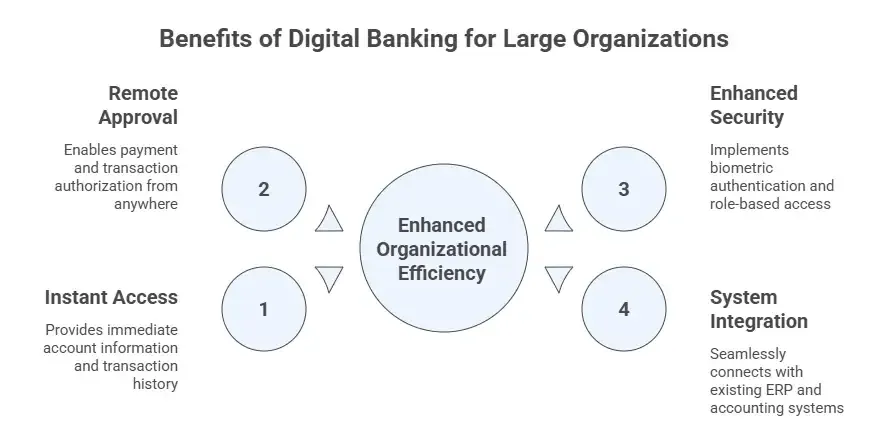
Corporate mobile banking has become the standard for financial management. For large organisations it brings clear benefits:
- Instant access to balances and transaction histories
- Approve payments and authorise transactions remotely
- Stronger security, with biometric authentication and role-based access
- Integration with existing ERP and accounting systems
A recent survey shows over 75% of large companies use mobile banking apps for everyday tasks. Deloitte's Digital Banking Maturity 2024 report says 78% of corporate operations in digitally advanced countries now happen through mobile apps. The corporate mobile banking market reached $2.8 trillion in 2024, growing at a 19.3% CAGR.
For example, by mid-2024 Bank of America's CashPro app processed over $500 billion on mobile, a 40% increase on the year before, with a 2024 forecast above $1 trillion. CashPro now offers 83 functions in one interface, including instant payment approvals, FX deals and direct integration with SAP, Xero and Oracle NetSuite.
Mobile banking is now essential for any business that wants to stay competitive.
Banking super app: one place for financial operations
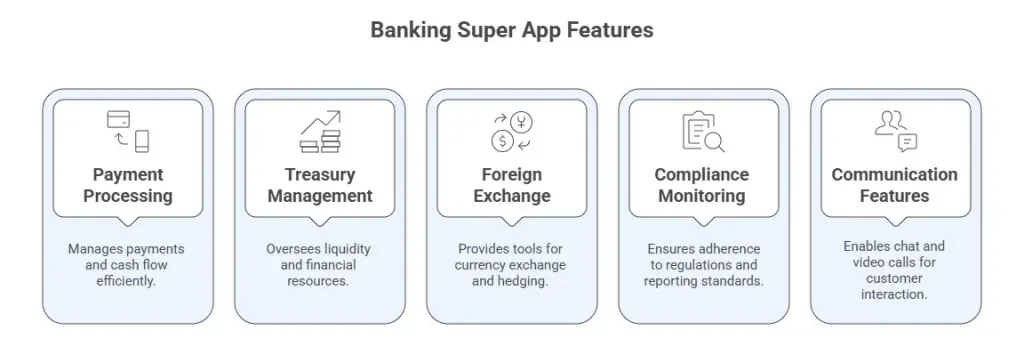
Banking super apps are changing how businesses manage finance. Unlike a traditional banking app, a super app combines many financial tools in one place, which simplifies operations and cuts complexity for finance teams.
A banking super app usually includes:
- Payment processing and cash management
- Treasury and liquidity management
- Foreign exchange and hedging tools
- Compliance monitoring and reporting
- Communication features like chat and video calls
By bringing these together, super apps remove the need for many platforms and manual data transfers. Finance teams get everything from one interface, which improves efficiency and reduces errors.
Siemens uses JPMorgan's Liink blockchain network to speed up cross-border operations that used to take 3-5 business days; now a transaction completes in 12 seconds. Liink also connects to JPMorgan's API ecosystem, so Siemens can track transactions globally and manage banking risk from mobile.
The Commercial Bank of Dubai was the first in its region to deploy Liink. It partnered with Microsoft Copilot and added blockchain features. Its corporate super app has treasury and accounting tools, video chat with bankers, AI recommendations and real-time reporting.
Here is how traditional mobile banking apps compare with banking super apps:
Feature | Traditional Mobile Banking | Banking super app |
Payments & | Yes | Yes |
Treasury Management | Limited | Advanced |
FX & | Basic | Integrated |
AI Insights | Rare | Core Feature |
ERP Integration | Partial | Full |
Communication Tools | No | Embedded |
Customisation | Minimal | High |
Super apps are built for flexibility. Their modular architecture lets a business add or remove features as needed, which matters for organisations whose requirements change.
Other advantages of banking super apps:
- Central control over financial operations
- Better collaboration between finance, treasury and operations teams
- Faster onboarding for new users and departments
Real-time treasury management
Real-time treasury management is now vital. Seeing cash positions, forecasting liquidity and managing risk instantly makes for far better decisions.
With it, finance teams can:
- Monitor global cash balances across accounts and currencies
- Forecast future cash flows from current data
- Automate transaction reconciliation
- Get alerts for liquidity issues or unusual activity
These help organisations use working capital well and respond quickly to the market. Real-time data cuts errors and supports accurate planning.
Practical benefits include:
- Faster sight of funding needs
- Better compliance with internal policies
- Stronger handling of foreign-exchange risk
Real-time treasury management gives finance teams the confidence to act quickly and decide well.
Banking mobile apps are WislaCode speciality
Let's start the conversation and develop a solution for your bank that allows you to grow and scale your customer experience.
AI in corporate banking
AI is becoming central to corporate banking. It is not only automation: it gives deeper insight and supports better decisions.
AI features in mobile banking and super apps include:
- Predictive analytics for cash-flow forecasting
- Automated compliance checks and fraud detection
- Personalised experiences based on role and behaviour
- Smart onboarding with document recognition and natural language processing
These let finance teams work more efficiently and focus on high-value work. AI can spot patterns manual analysis misses, which helps with proactive risk management and planning.
Some of the ways AI is changing corporate banking:
- Cutting operating costs by automating routine tasks
- Improving accuracy in financial reporting
- Supporting customers with AI-driven chatbots
AI also makes it easier to connect banking platforms with other business systems. Open APIs and machine learning enable clean data exchange and smarter workflows.
Few successful projects of WislaCode


Why choose WislaCode Solutions for corporate mobile banking
At WislaCode Solutions we have deep experience building advanced software for banks and fintechs. Our team builds secure, easy-to-use mobile banking platforms, super apps and scalable treasury management tools.
Every organisation is different, so we build custom solutions - from role-based dashboards to AI-driven onboarding and full ERP integration. We focus on quality, which helps clients succeed in a fast-changing financial world.
WislaCode Solutions is here to help. Contact us to learn how we can support your goals.
What is business mobile banking, and how does it benefit large organisations?
Business mobile banking allows companies to manage their financial operations through secure mobile applications. It offers instant access to account balances, transaction approvals, and cash flow monitoring, enabling executives to make decisions on the go. For large organisations, this means greater efficiency, reduced reliance on desktop systems, and the ability to respond swiftly to financial demands, all while maintaining robust security protocols.
How does corporate online banking differ from traditional banking methods?
Corporate online banking provides a digital platform for businesses to handle financial tasks, such as payments, reconciliations, and reporting, often via mobile or web interfaces. Unlike traditional methods that rely on in-person visits or manual processes, it offers real-time data access and seamless integration with tools like ERP systems, streamlining operations and reducing administrative burdens for finance teams.
Why are banking super apps becoming essential for enterprises?
Banking super apps combine multiple financial functions, such as payment processing, treasury management, and compliance monitoring, into a single platform. This unified approach reduces the need for multiple tools, enhances collaboration across departments, and improves operational efficiency. For enterprises, super apps provide a customisable solution that adapts to evolving business needs, saving time and minimising errors.
How does real-time treasury management improve financial decision-making?
Real-time treasury management enables finance teams to monitor cash positions, forecast liquidity, and identify risks instantly. By providing up-to-date data across multiple accounts and currencies, it supports faster, more informed decisions. For example, businesses can quickly address funding gaps or optimise working capital, ensuring they remain agile in dynamic market conditions.
What role does AI in corporate banking play in enhancing efficiency?
AI in corporate banking transforms how businesses operate by automating routine tasks, such as compliance checks and transaction reconciliations, and providing predictive insights for cash flow planning. It also personalises user experiences through role-based dashboards and enhances risk management by identifying patterns that might go unnoticed, allowing finance teams to focus on strategic priorities.
How does mobile banking security ensure the safety of corporate transactions?
Mobile banking security incorporates advanced features like biometric authentication, role-based access controls, and encryption to protect sensitive financial data. These measures ensure that only authorised personnel can access accounts or approve transactions, reducing the risk of fraud. Regular security updates and compliance monitoring further safeguard corporate finances in a mobile environment.