

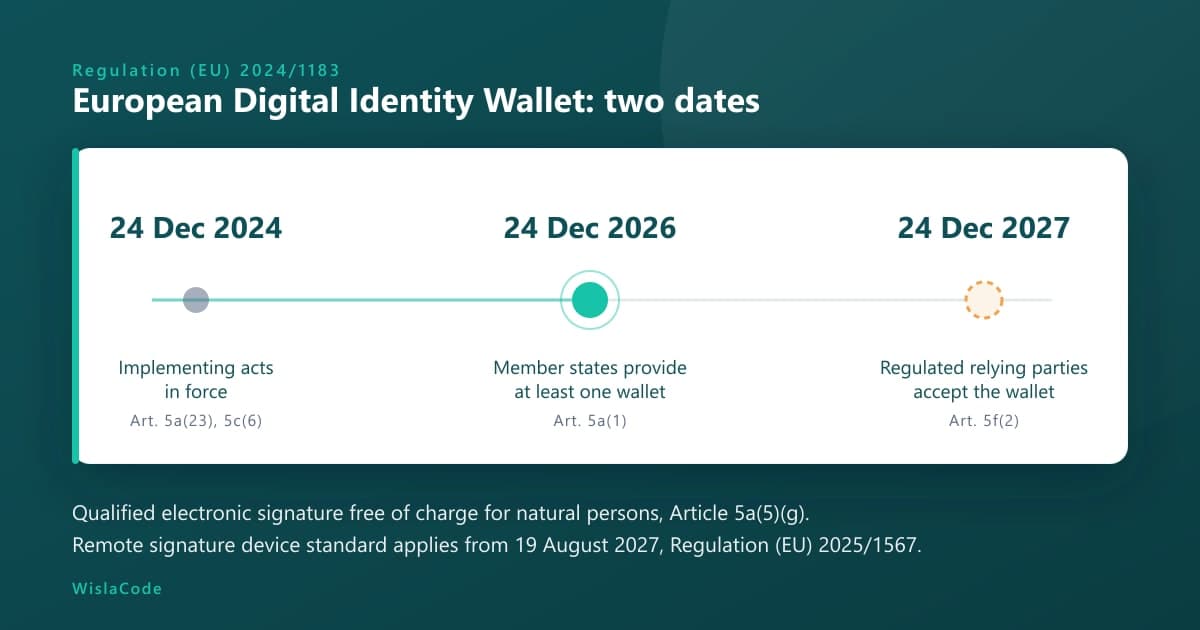
Two dates sit inside eIDAS 2.0 and they are a year apart. By 24 December 2026 every member state has to provide at least one European Digital Identity Wallet. By 24 December 2027 a bank, lender or payment firm required to use strong user authentication for online identification has to accept one when a customer asks. The first is a delivery obligation on governments. The second opens with a registration that gates everything else, and both dates trace to article numbers a delivery team can plan against.
Where the December 2026 date comes from
Article 5a(1) of Regulation (EU) 2024/
Acceptance runs on a different clock. Article 5f(2) gives private relying parties 36 months from the same starting point, so 24 December 2027. It bites where Union or national law, or a contract, requires strong user authentication for online identification, and it names banking and financial services alongside transport, energy, social security, health, drinking water, postal services, digital infrastructure, education and telecommunications. Micro and small enterprises are outside it, and acceptance is triggered only on the voluntary request of the user.
Obligation | Who it binds | Source | Date |
|---|---|---|---|
Provide at least one wallet | Every member state | Article 5a(1) | 24 December 2026 |
Accept the wallet for public services | Public sector bodies requiring eID | Article 5f(1) | In force since 20 May 2024 |
Accept the wallet | Private relying parties in the listed sectors | Article 5f(2) | 24 December 2027 |
Accept the wallet | Very large online platforms under the Digital Services Act | Article 5f(3) | No separate date in the text |
What the wallet hands a verifier
The wallet runs at assurance level high (Article 5a(11)), and issuance, use and revocation are free of charge to all natural persons (Article 5a(13)). It carries person identification data and electronic attestations of attributes, with selective disclosure under the sole control of the user (Article 5a(4)(a)). Article 5a(16) goes past a privacy statement: the technical framework must stop an attestation provider from obtaining data that tracks, links or correlates transactions, and must support unlinkability where the attestation does not require identification.
Formats are settled in the implementing acts. Annex II to Implementing Regulation (EU) 2024/
Attribute attestations matter as much as the identity set. Annex VI lists what member states must make verifiable against an authentic source, and the entry a business onboarding team should read twice is powers and mandates to represent a natural or legal person. It stands in for the extract-and-read work behind every corporate account opening. Age, professional licences and, for legal persons, financial and company data sit on the same list.
One rule arrived in July 2026 and changes what a customer file may hold. The new Article 3a of Implementing Regulation (EU) 2024/
Registration comes before the integration
Article 5b(1) requires a relying party to register in the member state where it is established. The registration declares the intended use and indicates the data to be requested (Article 5b(2)(c)), and Article 5b(3) then forbids requesting anything else. The attribute request schema becomes a registered artefact, so a product change that adds one field is also a registration update under Article 5b(6).
Implementing Regulation (EU) 2025/
Three clauses in Article 5b shape the flow itself. The relying party identifies itself to the user (5b(8)). It is responsible for authenticating and validating the data it receives, and may not refuse a pseudonym where the law does not require identification (5b(9)). An intermediary acting for a relying party is itself a relying party and may not store data about the content of the transaction (5b(10)). That last clause rules out routing identity traffic through a vendor that keeps its own copy.
Mapping the wallet onto your onboarding stack?
WislaCode builds the integration layer between customer channels and the core for banks and lenders in the EU, including identity, KYC and signing flows that have to answer to a supervisor.
Remote qualified signatures in a lending flow
A wallet signs. Article 5a(4)(e) lets the user sign with a qualified electronic signature, and Article 5a(5)(a)(xi) requires the protocols that create one. Article 5a(5)(g) says the wallet offers every natural person that ability by default and free of charge, with a carve-out: member states may take proportionate measures limiting free use to non-professional purposes. A consumer signing a loan agreement will probably sign for nothing; a director signing for a company falls outside the limit and somebody pays for the certificate.
Legal weight comes from Article 25(2) of Regulation (EU) No 910/
The reference standard now has a name and a date. Implementing Regulation (EU) 2025/
- The lender renders the agreement and computes the hash.
- The customer authenticates to the qualified trust service, with the wallet as one accepted means.
- The provider activates the signing key in the remote device under the signatory's sole control.
- The provider returns the signature, and the lender assembles and validates the document.
- The validation result and the trusted-list evidence go into the case file.
Two neighbouring regimes decide how much of this a bank can reuse. Recital 62 of Regulation (EU) 2024/
On the anti-money-laundering side, Article 22(6)(b) of Regulation (EU) 2024/
What breaks first in a wallet integration
We build this layer for banks and lenders. The parsing is rarely what fails. Three other things do, in a predictable order.
Trust anchors go first. A verifier has to decide whether the wallet in front of it is genuine, and that answer comes from trust lists rather than from the credential. Version 3.0.0 of the Architecture and Reference Framework, published on 23 July 2026, requires wallets, relying parties and issuers to support both trusted lists under ETSI TS 119 612 and lists of trusted entities under ETSI TS 119 602. Those lists change. A service that caches them and never refreshes passes staging, then rejects genuine wallets months later with an error nobody can reproduce. Build the refresh and the staleness alarm before the happy path.
Certificates expire on their own schedule. The access certificate under Article 7 of Implementing Regulation (EU) 2025/
The identity model inside the bank is third, and usually the oldest. Article 5b(9) forbids refusing a pseudonym where the law does not require identification, and Article 5a(4)(b) has the wallet generate pseudonyms and store them locally. A customer table keyed on a national identifier will not hold that shape. Find out early whether the core can carry a customer whose stable key is a pseudonym for one service and a full identity set for another. That answer decides whether this is an integration or a migration.
Then order the work. Registration first, because it gates the certificates and moves at the speed of a legal review. One verifier service second, with both credential formats behind a single internal interface, so the application layer never asks whether it received an SD-JWT VC or an mdoc. The wallet handover last, because the deep link and the browser redirect are where session binding goes subtly wrong. The Commission publishes a reference implementation and a conformance suite alongside the framework; test against those rather than against whichever national pilot you can reach. We ordered it that way on a regulated consumer credit platform, where two KYC providers had to be integrated and the integration layer absorbed the difference.
Where Poland stands
Poland is a useful check on how the deadline behaves. The Ministry of Digital Affairs said on 4 March 2026 that the wallet will reach users through the mObywatel application, as a pilot at the end of 2026, unlocked by a one-off strong authentication with the electronic layer of the national identity card. The implementing bill, UC122, amends the Act on trust services and electronic identification; it went out for consultation on 19 February 2026, with adoption by the Council of Ministers listed for the third quarter of 2026. A pilot arriving on the deadline is the realistic picture across much of the bloc, so plan for a thin wallet population through 2027 and treat the fallback path as a first-class flow.
Planning the December 2027 acceptance duty?
We scope the verifier service, the relying-party registration and the signing flow as one piece of work, and hand over a design your supervisor and your delivery team can both read.
What is eIDAS 2.0 and how does it differ from the original eIDAS regulation?
eIDAS 2.0 is Regulation (EU) 2024/1183, which amends Regulation (EU) No 910/2014 and entered into force on 20 May 2024. The 2014 framework covered mutual recognition of national electronic identification schemes and trust services, and left wallets out of the picture. The amendment adds the European Digital Identity Wallet as an obligation on every member state under Article 5a(1), creates electronic attestations of attributes as a trust service, and defines remote qualified signature creation devices in Article 29a.
When exactly must EU member states make the digital identity wallet available?
By 24 December 2026. Article 5a(1) gives member states 24 months from the entry into force of the implementing acts referred to in Article 5a(23) and Article 5c(6). Those five acts were adopted on 28 November 2024, published in the Official Journal on 4 December 2024, and entered into force on the twentieth day after publication.
Which sectors are required to accept the European Digital Identity Wallet?
Article 5f(2) names transport, energy, banking, financial services, social security, health, drinking water, postal services, digital infrastructure, education and telecommunications. It applies to private relying parties in those areas that are required by Union or national law, or by contract, to use strong user authentication for online identification, and it exempts microenterprises and small enterprises. The duty starts on 24 December 2027 and is triggered only on the voluntary request of the user.
What is a remote qualified electronic signature and is it legally binding?
It is a qualified electronic signature where the signature creation device is managed by a qualified trust service provider on behalf of the signatory, defined in Regulation (EU) 2024/1183 and governed by Article 29a. Article 25(2) of Regulation (EU) No 910/2014 gives a qualified electronic signature the equivalent legal effect of a handwritten signature, and Article 26(c) requires the signature creation data to be used under the sole control of the signatory. The reference standard, ETSI TS 119 431-1 V1.3.1, is set by Implementing Regulation (EU) 2025/1567 and applies from 19 August 2027.
How does the wallet handle data privacy and GDPR compliance?
Article 5a(4)(a) requires selective disclosure under the sole control of the user, so a relying party receives the attributes it registered for and nothing more. Article 5a(16) requires the technical framework to stop attestation providers from obtaining data that would let them track, link or correlate transactions, and to support unlinkability where the attestation does not require identification. Article 5b(3) caps the request itself: a relying party may not ask for data it did not declare at registration.
Does eIDAS 2.0 require the Cloud Signature Consortium API for remote signing?
The EU acts name no vendor or consortium API. What they name is the service: Article 29a of Regulation (EU) No 910/2014 governs the management of remote qualified signature creation devices as a qualified trust service, and Implementing Regulation (EU) 2025/1567 of 29 July 2025 sets ETSI TS 119 431-1 V1.3.1 as the reference standard for it from 19 August 2027. A commercial signing API is an implementation choice, and conformance with that standard is the question to put to the provider.