

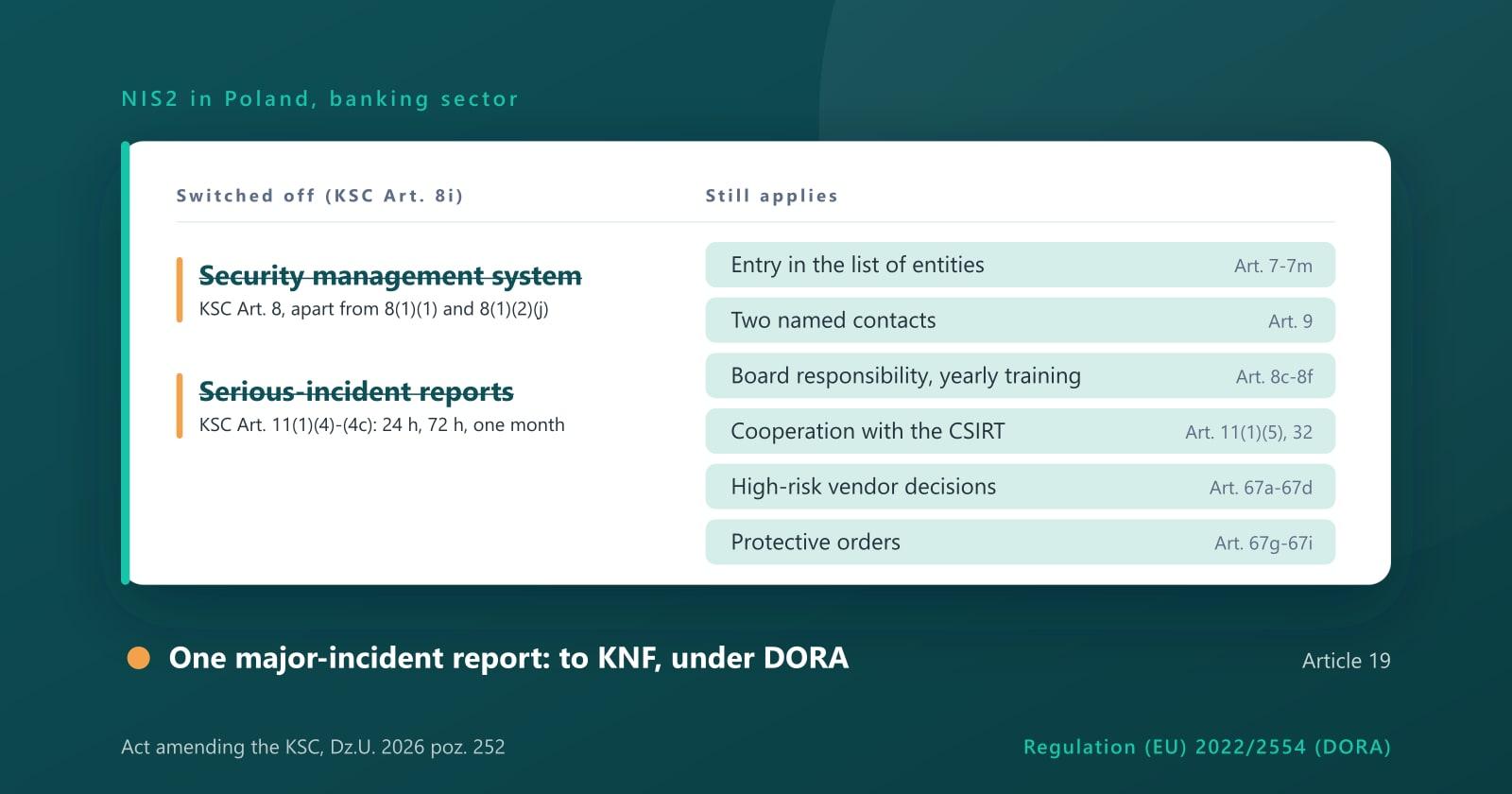
A Polish bank that complies with DORA reports its incidents once, to KNF, and runs one ICT risk management framework. The amended Act on the National Cybersecurity System (the KSC), in force since April 2026, switches off its own security management and incident reporting rules for the banking sector. What it keeps is a closed list of duties: registration and work in the minister's cybersecurity system, contacts and a reporting channel for customers, the board's responsibility and yearly training, cooperation with the national CSIRTs, including their security assessments and vulnerability deadlines, and the high-risk vendor regime.
That list is easy to miss: the act reaches 18 sectors of the economy, and for banks it reads as a set of exceptions. This article goes through it from a bank's side and ends with what the bank's systems need for the part that remains. For the DORA side, see our explainer on what DORA asks of the systems you build; our banking software development team builds the systems both laws read.
How DORA and the KSC divide the work
DORA takes the place of NIS2 for a bank's ICT risk management and incident reporting, and Polish law follows the EU text closely here. NIS2 Article 4(1) says that where a sector-specific Union act requires risk-management measures or incident notification at least equivalent to NIS2, the matching NIS2 provisions, supervision and enforcement included, do not apply. DORA Article 1(2) declares itself that act for financial entities that are essential or important entities, and recital 28 of NIS2 tells member states not to apply its risk-management, reporting and supervision provisions to them.
Poland transposed NIS2 with the Act of 23 January 2026 amending the KSC, published in the official journal, Dziennik Ustaw, on 2 March 2026 and in force a month later. The new Article 8i(1) of the KSC says its provisions on the information security management system and on reporting serious incidents do not apply to essential and important entities of the banking and financial market infrastructure sector, with a closed list of exceptions. KNF, the Polish Financial Supervision Authority, is the competent authority for the sector under both laws.
Obligation | Where it sits for a Polish bank | Source |
|---|---|---|
ICT risk management framework | DORA Chapter II; two points of KSC Article 8 stay: systematic risk assessment and basic cyber hygiene | KSC Art. 8i(1), 8(1)(1), 8(1)(2)(j) |
Major incident reports | DORA, to KNF only; KNF forwards them to the national CSIRTs | DORA Art. 19; supervision act Art. 18zg |
Cooperation while an incident is handled | Work with the CSIRT, pass it the data it needs, answer its requests for technical information | KSC Art. 11(1)(5), 32(3) |
Vulnerabilities and security assessments | Remove a vulnerability by the deadline set at a CSIRT's request; a CSIRT may assess the bank's systems | KSC Art. 11(1)(6), 32(2), 36a-36b |
Registration and the minister's system | Entry in the list of essential and important entities, then work in the minister's ICT system | KSC Art. 7-7m, 9(1)(4), 46 |
Contacts and customers | Two named contacts; guidance on cyber threats and a way for customers to report them | KSC Art. 9(1)(1)-(3) |
Board and staff | The head's responsibility and duties, yearly training, criminal-record checks for security staff | KSC Art. 8c-8f, applied with the necessary adjustments |
High-risk vendors and protective orders | Decisions of the minister for digital affairs bind the bank | KSC Art. 67c-67d, 67g-67i |
Supervision and fines | KNF, for the duties above | KSC Art. 41, chapters 11 and 14 |
One incident report, forwarded by KNF
A Polish bank reports a major ICT-related incident once, to KNF, in the DORA format and on the DORA clock. Delegated Regulation (EU) 2025/
DORA allows a member state to make financial entities also send the same reports to the NIS2 CSIRTs. Poland did not use that option. Under Article 18zg of the Act on financial market supervision, the financial entity reports to KNF, and KNF forwards without delay the reports of essential and important financial entities to CSIRT MON, CSIRT NASK or CSIRT GOV, the national teams run by the defence ministry, the NASK research institute and the Internal Security Agency. The KSC's own 24-hour early warning and 72-hour notification to a sectoral CSIRT (Article 11(1)(4) and (4a)) are not on the list of provisions that still apply to banks.
What does land on the bank is the work around the report. The bank cooperates with the competent CSIRT while a serious or critical incident is handled, passing it the data it needs, personal data included (Article 11(1)(5)), and hands over technical information about the incident when a national CSIRT asks for it (Article 32(3)). Where a vulnerability led or could lead to a serious incident, the CSIRT can ask KNF to call on the bank to remove it by a set date, and the bank reports the fix to KNF (Articles 32(2) and 11(1)(6)). A CSIRT can also run a security assessment of the systems the bank uses (Article 36a).
The board's own responsibility
Under the KSC the head of the entity answers personally for the cybersecurity duties, and for a bank that applies with the necessary adjustments (Article 8i(2)). Where the head is a board and no single person has been named, every member is responsible (Article 8c(2)), and handing the work to someone else does not move the responsibility (Article 8c(3)). The head decides on the security management system, plans the budget for cybersecurity duties, assigns the tasks and oversees them (Article 8d). The head, and the person entrusted with the head's cybersecurity duties, complete training once every calendar year, and the attendance is documented (Article 8e). A person who is to do the security or incident work first shows a certificate from the National Criminal Register that they have no conviction for offences against the protection of information (Article 8f(1)).
DORA already asks the management body to define, approve, oversee and be responsible for the ICT risk management framework and to keep its knowledge current through regular training (Article 5(2) and 5(4)). The KSC adds a yearly training cycle with a record KNF can ask for, and a choice for the board: name the person responsible, or every member answers.
An essential entity can be fined up to EUR 10 million or 2% of its revenue, whichever is higher, and an important entity up to EUR 7 million or 1.4% of its revenue (Article 73(3) and (4)). The head of the entity can be fined up to 300% of their remuneration, calculated by the rules for the cash equivalent of unused leave (Article 73a(4)). Under Article 35 of the amending act, these fines can first be imposed two years after the act took effect, which means April 2028 at the earliest. The fine of up to PLN 100 million for a breach that creates a direct and serious cyber threat, or a threat of serious damage or serious disruption of services (Article 73(5)), is not covered by that delay.
High-risk vendors
The high-risk vendor regime applies to banks in full. The minister for digital affairs can declare a supplier of hardware or software, together with the companies in its capital group, a high-risk vendor (Article 67b). From then on, essential and important entities may not put into use the types of ICT products, ICT services and ICT processes the decision covers, and must withdraw them within seven years of the decision's publication in the official gazette, Monitor Polski (Article 67c(1)). Until then, repairs, upgrades, replacement parts and updates of what is already in use are allowed where service quality and continuity need them (Article 67c(3)). Banks also report on what they are withdrawing when asked (Article 67d), and during a critical incident the minister can issue a protective order to an open-ended group of entities (Article 67g).
Smaller financial entities that are neither essential nor important are caught too: Articles 67c, 67d, 67g and 67h apply to them, unless they are among the entities listed in DORA Article 16(1) (KSC Article 67k). The President signed the act and referred it to the Constitutional Tribunal for review, naming the 18-sector scope, the high-risk vendor rules, the protective orders, the decision procedure and the fines. A review after signature does not stop the act taking effect.
Mapping DORA and the KSC onto one set of systems?
WislaCode builds banking software for banks, lenders and payment companies in the EU, with incident records, inventories and audit trails designed in from the start.
What a bank's systems need for the part that remains
The remaining duties land on four places in the bank's systems: incident handling, the inventory of what it runs, the governance record, and the channels it keeps open to customers and the CSIRTs.
- An incident record a CSIRT can be given quickly. The reporting pipeline stays as DORA built it, with one classification and one recipient. What changes is the follow-up: when a CSIRT asks for technical information during handling, the bank exports logs, indicators and the timeline from the incident record. The CSIRT can ask for personal data too (Article 11(1)(5)), so the record should mark it, and the bank can pass exactly what is needed.
- An inventory that answers a high-risk vendor decision. A decision names a supplier, its capital group and types of products, services and processes. The bank needs to find every system running them, hardware and licensed software included, and plan their replacement inside seven years while repairs and updates stay allowed. That means supplier, its group and product type on every asset record.
- One governance record. The list entry has to be corrected within 14 days of any change in its data, which include the bank's IP address ranges and domain names (Article 7c(3)). Two contacts stay named and reachable, the board's yearly training is documented, and the criminal-record certificates of security staff are on file. These belong in the same records the bank keeps for DORA Article 5, since KNF reads both.
- Open channels to customers and CSIRTs. Customers need guidance on cyber threats and a way to report a threat, incident or vulnerability in the bank's services (Article 9(1)(2) and (3)). Once listed, the bank works in the minister's ICT system (Article 9(1)(4)). Its vulnerability process has to meet a removal deadline KNF sets at a CSIRT's request, and it has to support a CSIRT security assessment of its systems.
For item 2, replacing a core component without stopping the bank is what our integration layer is built for.
The timetable is in the act. Banks already in scope when the act took effect have 12 months to meet the duties of the KSC's chapter 3, so until April 2027 (Article 33(1) of the amending act). Registration and the start of work in the minister's ICT system follow a schedule the minister publishes (Articles 33(3) and 34(3)). Most fines can first be imposed in April 2028. Each high-risk vendor decision opens its own seven-year withdrawal window.
Core and channel work we've already shipped
Planning for a high-risk vendor decision?
WislaCode builds the integration layer that lets a bank replace a core component while it keeps serving customers.
Does DORA replace NIS2 for banks in Poland?
For ICT risk management, incident reporting and their supervision, yes. Article 8i(1) of the amended KSC switches off its security management and serious-incident reporting provisions for the banking sector, as NIS2 Article 4 and DORA Article 1(2) provide. Still in force for banks: registration and work in the minister's ICT system, two named contacts, guidance and a reporting channel for customers, board responsibility and yearly training, criminal-record checks for security staff, cooperation with the CSIRTs including their security assessments and vulnerability deadlines, systematic risk assessment, basic cyber hygiene and the high-risk vendor rules.
Where does a Polish bank report a major ICT incident?
To KNF, under DORA Article 19, using the DORA templates and time limits. KNF forwards the reports of essential and important financial entities to CSIRT MON, CSIRT NASK or CSIRT GOV (Article 18zg of the Act on financial market supervision), so the bank does not send a separate NIS2 notification.
Does a Polish bank have to register under the KSC?
Yes. Essential and important entities, banks included, are entered in the list of essential and important entities, and KNF keeps the banking-sector entries (KSC Article 7(4)). A bank that was an operator of essential services under the old act is entered by the minister without an application (Article 34(2) of the amending act); another bank already in scope in April 2026 files on the schedule the minister publishes (Articles 33(3) and 34(3)); a bank that comes into scope later files within six months (Article 7c(1)). Changes to the registered data go in within 14 days (Article 7c(3)).
Can bank board members be fined personally under the KSC?
Yes. The head of an essential or important entity can be fined up to 300% of their remuneration, calculated by the rules for the cash equivalent of unused leave (Article 73a(4)), and where a board has named no responsible person, all its members answer (Article 8c(2)). Under Article 35 of the amending act, such fines can first be imposed two years after its entry into force, which means April 2028 at the earliest.
Is every Polish bank an essential entity under NIS2?
No. A bank above the EU medium-sized enterprise thresholds is an essential entity and a medium-sized one is an important entity (KSC Article 5(1)(1) and 5(2)(1)). A financial entity that is neither is still bound by the high-risk vendor obligations unless it is among the entities listed in DORA Article 16(1) (KSC Article 67k).
What is a high-risk vendor decision?
A decision of the minister for digital affairs that declares a supplier of hardware or software, with its capital group, high-risk (KSC Article 67b). Essential and important entities may not deploy the product, service and process types it covers and must withdraw them within seven years of its publication in Monitor Polski (Article 67c). The President referred these rules, among others, to the Constitutional Tribunal for review.