
PoC development
A working proof of concept that tests your riskiest integration first: authentication, data contracts and failure behaviour under load.
Results from work we have shipped
WislaCode helped Verysell Group Applied AI Lab explore the current state and future of AI testing, turning uncertainty into clear, actionable insights.
Shortlisting a software development partner?
The questions to ask in an RFP, three warning signs a vendor may not deliver, and a scoring matrix to compare contractors objectively.
How a PoC engagement runs?
Collaborate with our experts to shape your idea and intended outcomes. Assess technical feasibility and likely challenges. Define the core features and behaviours to be validated in the PoC.
Create wireframes and prototypes to visualise the concept. Develop a technical architecture that supports scalability and integration. Align the design with your brand identity and user expectations.
Build a functional prototype with essential features for validation. Ensure the build follows best practices for scalability, performance, and security. Integrate necessary technologies to simulate real‑world scenarios.
Run rigorous tests to evaluate functionality, usability, and performance. Collect feedback from stakeholders and early users to validate the concept. Refine the solution based on clear insights from testing.
Deliver the PoC in a format ready for stakeholder demonstration. Provide practical recommendations for next steps, including enhancements, risks, and dependencies.
What we build to prove a concept?
A thin but real connection to the system that worries you - a core banking platform, a payment provider, a legacy back office - proving authentication, data contracts and failure behaviour before any architecture is committed to it. The riskiest dependency gets tested first, not last.
Measured behaviour of the critical path under realistic data volumes and controlled load. Capacity claims in a business case should rest on numbers observed in conditions resembling yours, not on vendor benchmarks, and a baseline gives delivery a target it can be held to.
Model behaviour tested on your actual data against an agreed evaluation set: quality, coverage and failure modes. AI concepts fail on data far more often than on algorithms, so we put the data under test before any capability is promised to stakeholders.
Low-fidelity journeys first to move fast, high-fidelity where stakeholder credibility demands it. Built to test whether users actually do what the business case assumes they will, with feedback gathered against defined questions rather than collected as general impressions.
A working skeleton of the contested design decision - an event flow, a data pipeline, a synchronisation strategy - run end to end with realistic inputs. Arguments between architectural options get settled by observed evidence instead of by whoever holds the strongest opinion in the room.
Evidence that regulated data can move through the proposed design lawfully: consent flows, retention, residency and audit requirements surfaced while they are still cheap to address. For fintech and healthcare concepts this is often the assumption that actually decides feasibility.
An idea worth testing before it is worth funding?
Tell us the claim to prove and we will scope the smallest honest experiment.
What shapes the work
A proof of concept exists to support one decision: commit to the build, change the approach, or stop. Before that decision, the case for a project rests on opinion - an architect believes the integration will hold, a founder believes the data is good enough, a vendor believes the platform will take the load. Budget holders are right to distrust all three. A PoC replaces belief with measurement, at a cost small enough that a negative answer is affordable.
The first piece of work is therefore not code but framing. We write down what must be true for the project to be worth building, turn each assumption into a testable hypothesis, and agree in advance what evidence would count as proof - and, just as importantly, as disproof. If a result cannot change the decision, we do not spend time producing it.
That framing is what separates a proof of concept from an early build. A build asks how to make the thing; a PoC asks whether it should be made at all. Keeping that second question primary is the discipline, and it is why a good PoC is allowed to fail.
The common failure is not a PoC that fails - it is a PoC that cannot fail. A demo built on the happy path, with clean data and no awkward third party, will always succeed, and the organisation learns nothing except that its engineers can build demos. The second failure is drift: without a hard boundary, a feasibility test quietly grows into a small product, and stopping it starts to feel like waste rather than a finding.
We guard against both by designing the smallest honest test. Honest means the conditions that could realistically kill the project sit inside the scope, not outside it: the real shape of your data, the real behaviour of the third party, the constraint your sceptics keep raising. Small means everything else is excluded explicitly and in writing, so nobody can smuggle features in under the banner of validation.
Success criteria are fixed before the first line of code, which removes the temptation to move goalposts once results arrive. A negative result against pre-agreed criteria is a cheap and valuable outcome: it is the expensive build that did not happen.
Inside the time-box, engineering effort goes only where the uncertainty lives. The path under test - the integration nobody has tried, the algorithm nobody has run on your data, the workload nobody has measured - is built for real, against live endpoints and realistic data wherever access allows. Everything around it is simulated just well enough to keep the test valid, because every hour spent polishing the periphery is an hour not spent on the question.
The output is measurement, not impressions. Each hypothesis ends the engagement with a number, an observed behaviour or a documented failure, recorded alongside the conditions that produced it, so the result survives scrutiny from people who were not in the room when the demo ran.
AI concepts deserve particular caution. Their feasibility is decided by data quality and by model behaviour on your inputs, not by what a vendor demonstration suggests, so those are the first things we put under test - before any capability is promised on a roadmap.
Where an AI concept proves out and needs deeper model and data work, see our AI and ML development services.
A PoC is bought as a fixed time-box with a small senior team, not as open-ended discovery. That shape is deliberate: validation work expands to fill whatever time it is given, so the constraint is the method. A short framing phase, a build-and-measure core, and a closing stretch reserved for analysis and the decision pack, with a checkpoint partway through where weak hypotheses are cut and the strongest get the remaining time.
Two rules keep the commercial side honest. The end date does not move: when reality intrudes, we cut scope to protect the decision rather than extend budget to protect the scope. And the team is deliberately senior, because judgement is the product - many teams can assemble a prototype, far fewer can tell you what the results mean and what they do not.
Be clear about what the money buys. Not software - the build is a by-product - but a defensible answer: evidence strong enough to commit a much larger budget against, or to decline to. Set against the cost of a wrong full-scale build, a disciplined PoC is cheap insurance.
For what a time-boxed research engagement looks like in practice, see how we mapped the state and future of AI testing for Verysell Group's Applied AI Lab in five weeks.
Every engagement ends in a decision meeting, not a demo. The closing session sets what was measured against what was agreed at the start, names the assumptions that held and the ones that did not, and recommends one of three verdicts:
- Go: feasibility is proven, residual risks are named and priced, and the findings become the technical baseline for delivery
- Pivot: the goal survives but the approach does not, and one further narrow spike tests the alternative
- Stop: the evidence says the project should not proceed as conceived, before the expensive part began
A stop is not a failed engagement; it is the engagement doing its job. The work was commissioned to protect a large budget from an unproven assumption, and it did exactly that. Whichever verdict lands, the decision pack is written to stand on its own in front of a board or an investment committee: the evidence, the criteria it was judged against and the reasoning behind the recommendation.
When the verdict is a go, the next engagement is the MVP build - a PoC proves, an MVP ships.
We collaborated with WislaCode on a product strategy development project and gave the highest marks for this contractor. The WislaCode team delivered on time and with outstanding quality. I want to mention the team's transparency while running the project - everything was trackable, visible and manageable.
What is included in a PoC engagement?
A PoC is a production scope in miniature: a fixed time-box, named hypotheses and a decision at the end. Every engagement includes the same disciplines, scaled to the assumptions under test.
A framing workshop that turns your idea into written hypotheses, success criteria and an explicit list of what the PoC will not test.
A technical architecture sketch covering the integration points, data flows and constraints the validation build has to respect.
Wireframes or a clickable prototype where user behaviour is part of the question, validated with stakeholders before engineering effort is spent.
A working validation build that exercises the riskiest paths end to end, using real services where possible and stubs where not.
Structured testing against the acceptance criteria agreed in the framing workshop, with every result recorded against the hypothesis it answers.
A risk register that names each open threat to delivery, its observed evidence and a costed mitigation.
A final decision pack: findings, a go or no-go recommendation, and effort estimates for the step that follows.
At handover you own everything the time-box produced: code, prototypes, test data, findings and the decision pack. Nothing is licensed back, and nothing requires our involvement to use.
What is a PoC in software development, and when should we choose it over a prototype or MVP?
A proof of concept (PoC) is a focused validation exercise that tests feasibility and de‑risks the riskiest assumptions before full delivery. It answers “Can this work?” rather than “What will it look like?” (prototype) or “Will people buy it?” (MVP). Choose a PoC when uncertainty is technical or operational: architecture feasibility, integrations, performance, data handling, or compliance. Typical PoC outputs include architecture spikes, mock services, API proof points, and performance baselines in a time‑boxed window. If risk is mostly experiential, a prototype may be enough. If feasibility is proven and you need real usage evidence, move to an MVP. Many teams run a short PoC, validate UX with a prototype, then ship an MVP for market learning. A well‑scoped PoC reduces cost, clarifies the roadmap, and enables an objective go/no-go decision.
How do you scope and plan a PoC to stay time‑boxed and avoid scope creep?
We begin with hypotheses, constraints, and success criteria that define what the PoC must prove and what is out of scope. We prioritise a few validation threads - typically one technical (integration feasibility or performance target), one product (user value), and one delivery (dependency risk), each with acceptance criteria, metrics, and a clear test method. To stay time‑boxed, we use stubs and mock services, seed datasets, and the lowest‑effort path that proves feasibility. Daily risk checkpoints, a mid‑point cut, and a fixed end‑date ensure focus. The output includes demoable artefacts, findings, risks, and recommendations with effort estimates for the MVP. Every task must tie to a hypothesis, if it doesn’t prove or disprove a critical assumption, it waits for the MVP. This keeps the PoC small, fast, and conclusive.
What deliverables should we expect from a PoC engagement?
Expect decision‑ready outputs: a demoable PoC build that proves key assumptions; technical notes on architecture options, integration feasibility, performance baselines, and security considerations; and a concise risk register with mitigations. Discovery artefacts include hypotheses, success criteria, and acceptance tests; UX scope may include wireframes or clickable prototypes and user feedback notes. You also receive a practical roadmap to MVP with effort estimates, dependency mapping, and phased prioritisation. For compliance‑sensitive contexts, we add data handling approaches, consent flows, and audit needs. Where useful, we provide spike code, mock services, and test datasets so your team can reproduce results. The full pack supports stakeholder validation, a clear go/no‑go decision, and a smoother transition to delivery.
How do you handle integrations, performance, and security within a PoC’s limited scope?
We target the riskiest aspects with minimal effort. For integrations, we validate authentication, payload contracts, idempotency, and error handling using mock services first, then a thin real integration. For performance, we baseline the critical path - key API response times, page loads with realistic data, and queue behaviour under controlled load - to show scalability pathways. For security, we demonstrate sound foundations: secrets management, basic access controls, safe data handling, and document hardening for the MVP (encryption, audit, compliance controls). This yields credible proof points - architecture options that work, performance tracking to targets, and security considerations that won’t derail delivery, while keeping the PoC lean, time‑boxed, and affordable. Findings feed the risk register and MVP roadmap.
What timeline and budget range are typical for a PoC, and what variables affect them most?
Most PoCs complete within four to eight weeks, shaped by uncertainty level, integration access, and the need for user research. Narrow technical spikes (a single integration or performance concern) can finish in two to four weeks. Broader PoCs with discovery, prototyping, and multiple integrations trend towards six to eight weeks. Budget depends on team mix (engineering, UX, QA), environment setup, and third‑party access. The biggest variables are integration readiness (sandboxes, documentation, credentials), sample data availability, and stakeholder decision latency. We control cost and time via strict scoping, time‑boxing, and an evidence‑first plan that prioritises the riskiest assumptions. You’ll know what “done” means, how it’s measured, and what defers to MVP, enabling confident approvals and avoiding rework.
How does a PoC translate into an MVP and full delivery without losing momentum?
We plan the handover from day one. Validated architecture patterns form the baseline. Integration contracts and stubs turn into production adapters. Performance baselines guide non-functional requirements. UX prototypes help create the MVP backlog. Handover includes a structured transition pack with: Prioritised user storiesAcceptance criteriaTechnical recommendationsKnown risksDependency mappingEffort estimates by phaseWe propose a delivery cadence with decision gates and measurable outcomes; where appropriate, a limited pilot validates adoption and support needs. This continuity - from feasibility to product value, minimises rework and shortens the runway to MVP. Stakeholders receive demoable artefacts and documentation that support a clear go/no‑go decision and a de‑risked plan to scale.
What happens if the PoC shows the concept is not feasible?
A no-go is a legitimate and useful result, and the engagement is structured so it can surface honestly. The decision pack documents what was tested, what the evidence showed and why the recommendation is to stop or change course, so the conclusion can be defended internally without re-running the work. In practice the outcome is often a pivot rather than a flat stop: the business goal survives while a specific architecture, vendor or data source is ruled out, and a short follow-up spike tests the alternative. Either way, the time-box has done its job - the cost of the PoC bought the avoidance of a far larger build that the evidence says would have struggled.
What should we bring to the framing workshop?
Come with the business case as it currently stands, including the numbers it relies on - the workshop's job is to find the assumptions doing the most load-bearing work, and those usually hide in the financial model rather than the technical design. Bring the colleagues most doubtful about the idea - the architect who questions the integration, the operations lead who has watched a similar project fail - because their objections convert directly into the hypotheses most worth testing. Records of prior attempts are valuable too, whether an abandoned prototype or a vendor evaluation, since they tell us what has already been disproven. Finally, any hard constraints - regulatory obligations, vendor contracts, fixed launch dates - so the test is designed inside the world the project will actually live in.
Can our in-house team take part in the PoC?
Yes, and it usually strengthens the result. We regularly run PoCs alongside client engineering teams: your engineers bring system context and institutional knowledge, ours bring the validation discipline and an outside view that is not invested in any particular answer. The framing workshop is run jointly, so the hypotheses reflect what your team already suspects but has not had the space to test properly. During the build we work as one team, with shared standups and a shared board. The benefit shows at the end: because the evidence was produced together, the verdict carries weight internally and the knowledge needed to act on it already lives in-house.
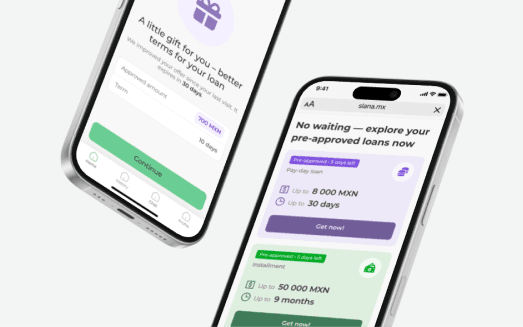
$lana (Monetech), a regulated multi-country consumer credit platform, needed its compliance and data integrations online inside a tight regulatory window. We owned the integration architecture and delivered.
View case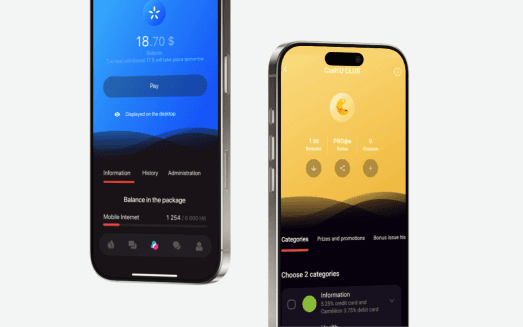
A consumer banking super app in a regulated market had to launch at scale inside a fixed regulatory and competitive window. We owned the integration architecture and mobile delivery.
View case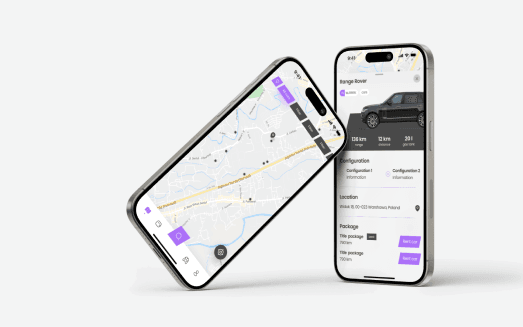
A design concept for a carsharing launch - a progressive web app approach, prototyped to be convenient for customers and efficient to run.
View caseWe've been working with WislaCode since July 2025. What started as enhancing the loyalty program in our GlobalTips guest app grew into a broader partnership where they now handle significant frontend development across our guest app, staff app, and web products.
This was a very task-heavy project, mostly exploration and R&D-driven. However, by the end of WislaCode, we were left with a detailed roadmap consisting of clear milestones - able to be converted into tangible KPIs - and some neat ideas of what actionable are next. Integrating...
We collaborated with WislaCode on a route-to-market optimisation project. Working with WislaCode was effective, transparent and predictable, which is especially critical for AI and ML projects. We provided them with six months of anonymised data, and within just three weeks...
Need a clear go or no-go answer?
Bring the riskiest assumption and we will design a proof of concept that settles it.