


Small and medium-sized businesses (SMEs) are the backbone of the economy - over 90% of businesses and more than half of global employment. Yet for many owners, banking is still a struggle. Why do so many SMEs fail to find banking that fits their needs, and how can embedded finance, super apps for business and digital onboarding help?
SME banking for the modern business
Digital has changed what SMEs expect from a bank. Visa reports that 68% of European SMEs use digital banking channels, and 17% have fully integrated digital tools into their operations. Still, many banks fall short for SMEs, especially outside Europe.
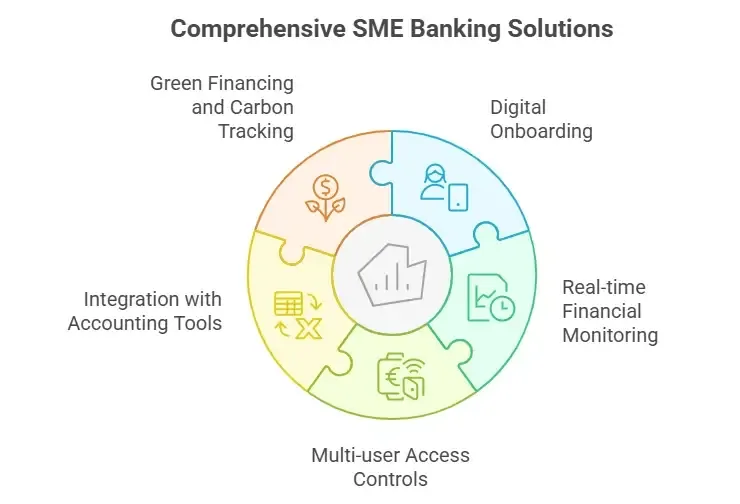
SMEs now want flexibility, speed and integration with their own processes. The best SME banking offers:
- Digital onboarding, which can cut account-opening times by up to 85% (McKinsey), removing paperwork and branch visits.
- Real-time financial monitoring, so owners make informed decisions and avoid cash-flow gaps.
- Multi-user access controls, so teams can manage payroll, expenses and approvals together.
- Integration with accounting tools like QuickBooks, saving time and cutting errors.
- Green financing and carbon tracking, for SMEs that want to operate more sustainably.
A recent MarksWebb report found SMEs value clear design, strong security and integration with third-party tools. In emerging markets, banks that focus on simple security and easy navigation tend to beat those with complex features.
Here is how what SMEs need compares with what many banks still offer:
SME Needs | Traditional Bank Offerings | Modern SME Banking Solutions |
|---|---|---|
Fast digital onboarding | Paper forms, branch visits | Online, minutes to activate |
Real-time cash flow monitoring | Delayed statements | Live dashboards, instant alerts |
Multi-user, role-based access | Single-user, basic permissions | Team management, clear controls |
Embedded finance and integrations | Siloed products, manual processes | API-driven, platform connections |
Green financing and sustainability | Limited or generic products | Custom tools, carbon tracking |
How embedded finance is reshaping SME banking
Embedded finance is changing how SMEs reach financial services. By putting banking, lending, insurance and payments into the platforms SMEs already use - e-commerce, ERP and accounting systems - banks and fintechs meet customers where they are.
In the MENA region, 65% of SMEs prefer digital banking, with growing demand for Sharia-compliant embedded finance. Saudi Arabia's Vision 2030 has driven fintech innovation, with platforms like Lendo offering peer-to-peer lending to local businesses.
In North America, despite high mobile use, only 35% of SMEs feel their banking needs are fully met (SAP Fioneer). Embedded finance helps close that gap with instant payments, personalised lending and value-added services through API-driven tools.
Benefits of embedded finance for SMEs
- Faster credit, with automated lending and alternative scoring models that use big data to approve loans quickly.
- Easier payments and collections, with built-in payment gateways and invoicing.
- Personalised products, such as insurance, export financing and tax calculators, inside business apps.
- Higher loyalty, as embedded finance keeps SMEs engaged and less likely to switch.
Few successful projects of WislaCode

Super app for business: unified financial services
The super app for business is gaining ground with banks and fintechs. Unlike a traditional banking app, it brings personal and business banking, investments, insurance, loyalty programmes and more into one platform.
What a super app for business offers
- One login for every service, so switching between personal and business accounts, payroll, vendor payments and expense tracking is simple.
- Modular dashboards, so users add or remove features as the business grows, from analytics to document management.
- Integration with e-commerce, ERP and accounting platforms for a clean workflow.
- Strong security, with biometric authentication and a consistent experience across mobile and web.
Super apps save time and build loyalty. As banks and fintechs race to build digital ecosystems, the super app for business is becoming a real advantage.
Digital onboarding for SMEs
Digital onboarding is now essential. By automating identity checks, compliance and document uploads, banks can onboard a new SME in minutes - which matters most where regulations are strict or SMEs work across borders.
Why digital onboarding matters
- Speed: accounts and credit are available instantly, with no paperwork or branch visits.
- Security: strong KYC and AML checks and digital signatures.
- Better experience: a smooth process lifts satisfaction and cuts drop-off.
As one client put it: “With digital onboarding, our business account was live in under 10 minutes. The process was straightforward, so we could focus on running the business instead of paperwork.”
Banking mobile apps are WislaCode speciality
Let's start the conversation and develop a solution for your bank that allows you to grow and scale your customer experience.
At WislaCode, our platforms are flexible, secure and easy to integrate, whether you are launching a super app for business, embedding finance into your ecosystem or streamlining digital onboarding for SMEs.
Every SME is different, so our solutions adapt to your business, your region and your growth plans. From instant payments in Europe to Sharia-compliant products in the MENA region, we build SME banking that matches the range of businesses we serve.
Ready to improve your SME banking? Let us help you build the future of business finance.
What are small business banking solutions, and why are they essential for SMEs?
Small business banking solutions offer tailored tools like digital financial services for SMEs. They enable faster account setup, real-time financial monitoring, and smooth integration with business platforms. These solutions help SMEs by offering flexibility and efficiency. They assist owners in managing cash flow and growing their businesses without the constraints of traditional banking.
How do digital onboarding platforms for SMEs streamline banking access?
Digital onboarding platforms for SMEs automate identity checks, compliance, and document submissions. This allows businesses to open accounts in minutes without visiting a branch. The speed and simplicity, along with secure KYC and AML processes, improve user experience and lower drop-off rates.
What benefits do integrated financial services for small businesses offer?
Integrated financial services for small businesses offer banking, lending, and payment solutions. These services are built into platforms like e-commerce or ERP systems. This allows for instant credit access, smoother payments, and personalised tools like insurance, boosting efficiency and customer loyalty.
How do all-in-one banking apps for businesses support SME growth?
All-in-one banking apps, known as super apps, bring together personal and business banking, payroll, and expense tracking on a single platform. With modular dashboards and integrations with tools like QuickBooks, they simplify workflows, save time, and improve security with biometric authentication.
Why are SME cash flow management tools critical for modern businesses?
SME cash flow management tools offer real-time dashboards and instant alerts. They help businesses avoid cash shortfalls and make informed decisions. By integrating with accounting platforms, these tools reduce errors and support sustainable financial planning, including green financing options.
How do API-driven financial ecosystems for SMEs improve banking services?
API-driven financial ecosystems for SMEs let banks connect financial services with third-party platforms. This offers seamless payments, lending, and analytics. Such connectivity supports personalised, Sharia-compliant, or region-specific solutions, meeting diverse SME needs and driving innovation.