

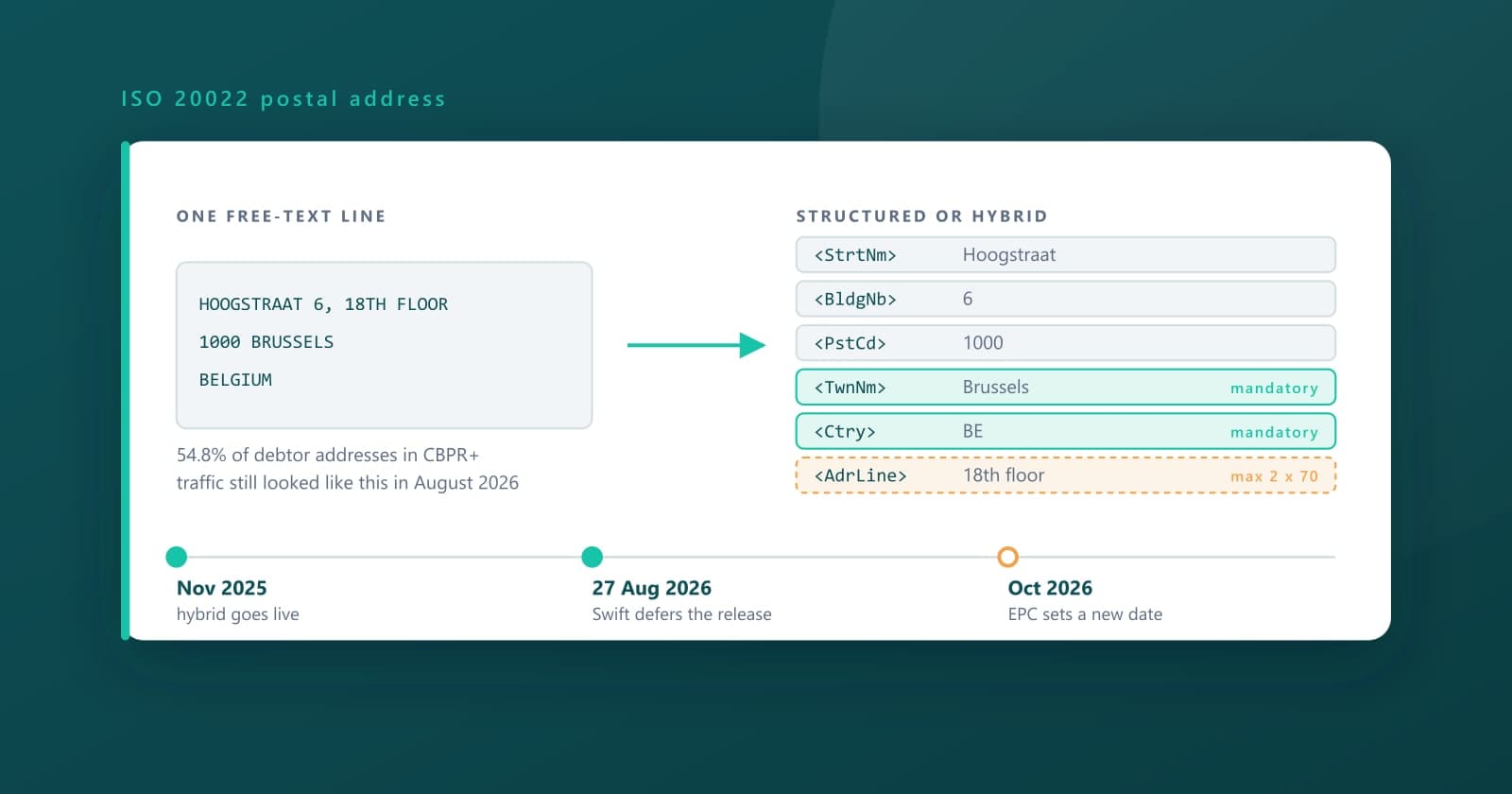
Less than it did a month ago. On 27 August 2026 Swift accepted a community request to extend the structured address migration for ISO 20022 payment messages and deferred every payments change in Standards Release 2026, including the network validation that was to reject fully unstructured postal addresses from 14 November 2026. The European Payments Council followed on 9 September, postponing the same end date under all five of its scheme rulebooks. The target format is unchanged, the hybrid option has been live since November 2025, and the address data sitting in your core banking system is in exactly the state it was in July. This is what still binds, and what to do with the months.
The three address formats, and the one being withdrawn
ISO 20022 has carried a structured postal address for far longer than any of these deadlines. The schema was never the hard part. Most banks hold the last mile of a customer address as one free-text line, because that is what a delivery label and an MT field both wanted, and splitting that line is a data project rather than a message-format project.
The PostalAddress component offers 14 structured attributes plus a free-text AddressLine. Interbank payment messages allow three combinations of them:
- fully structured: the structured elements only, with no AddressLine
- fully unstructured: AddressLine only, which is what most traffic still carries
- hybrid: structured elements together with AddressLine, available in CBPR+ and the leading market infrastructures since the November 2025 Standards Release
The hybrid option is the compromise that made the migration tractable, and it carries three rules worth knowing before anyone writes a mapper. Town Name and Country are mandatory inside PostalAddress, exactly as they are in a fully structured address. AddressLine is capped at two occurrences of 70 characters. Structured information must not be repeated in AddressLine, so a message that puts Brussels in both TwnNm and an address line is malformed and a receiving engine may read the town twice.
Element | ISO 20022 tag | Maximum length |
|---|---|---|
Street name | StrtNm | 70 |
Building number | BldgNb | 16 |
Building name | BldgNm | 35 |
Floor | Flr | 70 |
Post box | PstBx | 16 |
Room | Room | 70 |
Post code | PstCd | 16 |
Town name (mandatory) | TwnNm | 35 |
Town location name | TwnLctnNm | 35 |
District name | DstrctNm | 35 |
Country subdivision | CtrySubDvsn | 35 |
Country (mandatory) | Ctry | 2, ISO 3166-1 alpha-2 |
Department | Dept | 70 |
Sub department | SubDept | 70 |
Address line (hybrid only) | AdrLine | 70, up to two occurrences |
None of this makes an address mandatory. Under the EPC schemes an address is required where Regulation (EU) 2023/
Which rule belongs to whom
Coverage of this deadline tends to run four separate rulebooks together. They have different owners, different scopes and, as of this month, different dates.
- Swift CBPR+ is a network rule. Fully unstructured addresses were to be NAK'ed at network level from 14 November 2026, with no contingency measure. That validation is now deferred along with the rest of the payments release.
- Market infrastructures set their own dates. The Eurosystem moved the November 2026 releases of T2, T2S, TIPS and ECMS from 14 to 28 November 2026, and raised a fast-track change request, T2-0188-SYS, to keep accepting fully unstructured addresses in RTGS messages sent over A2A. The Bank of England deferred its own November 2026 RTGS standards release, which carries the CHAPS message standards, on the day Swift announced.
- Scheme rulebooks are third. The EPC had set 15 November 2026, and 03h30 CET for the instant schemes, replacing an earlier 22 November. Its Payment Scheme Management Board delayed that on 9 September 2026 and will set a new date in October.
- Regulation is the layer that has not moved. FATF published its revised Recommendation 16 on 18 June 2025, to come into effect by the end of 2030.
The T2 change request repays reading in full. It reopens fully unstructured addresses on the A2A channel for pacs.004, pacs.008, pacs.009, pacs.010, camt.029 and camt.056, and leaves the RTGS user interface accepting structured or hybrid only. It also records that the business validation rules deleted by the earlier change will not be restored, so a postal address that would have been flagged as an error before now passes. One system, two answers, depending on the channel a message arrives through.
Recommendation 16 is the reason none of this goes away. Above USD/
Date | What happens | Status |
|---|---|---|
18 June 2025 | FATF publishes the revised Recommendation 16 | In effect by end 2030 |
22 November 2025 | MT/ | Done |
27 August 2026 | Swift defers all payments changes in Standards Release 2026 | Done |
9 September 2026 | The EPC delays the end date under all five scheme rulebooks | Done |
October 2026 | The EPC's Payment Scheme Management Board sets a new end date | Pending |
28 November 2026 | T2, T2S, TIPS and ECMS November releases deploy, moved from 14 November | Confirmed |
By December 2026 | Swift reports on timing and approach for the structured address migration | Pending |
What to build while the date is open
The months bought back are build time. Swift's own readiness figures say where it should go: in August 2026, 54.8% of debtor addresses and 56.2% of creditor addresses observed in CBPR+ traffic were still fully unstructured. Those are the records that have to be split, and the splitting is the slow part.
The design question is where in the flow an address becomes structured. There are three placements, in rising order of what they cost to retrofit:
- At capture. The channel, the core banking party record and the corporate's own ERP hold the address in structured fields from the start, so the payment message is correct before it reaches the gateway.
- In one mapping service. A single component between the originating systems and the payment gateway owns parsing, lookup and the mapping into PostalAddress, and every channel goes through it.
- Per system, in an adapter. Each legacy source translates its own address format at its own boundary.
Most banks end up with all three: capture for new onboarding, a mapping service for the flows that come out of systems nobody will replace this decade, and adapters where a core cannot be touched at all. The placement matters less than the rule that there is exactly one implementation of the mapping. Two systems that both believe they own the address will keep overwriting each other, and that costs more than any parser.
The part most plans underweight is that the mapping runs in both directions and to more than one target. The PMPG guidance sets out three schemes for it. Hybrid to MT uses option F, with the name in subfield 1, the address lines in subfield 2, and country, town and post code in subfield 3. Hybrid to a market infrastructure that does not yet support hybrid folds everything back into up to three address lines of 35 characters, comma separated. The third scheme covers returns and warehoused payments that straddle a cutover, where a pacs.004 generated after go-live has to carry a structured address derived from a message that never had one. For that case the guidance allows the literal value CUTOVER2026 in Town Name, for three months only, with Country derived from the creditor agent's BIC as a last resort and the institution carrying the risk of that being wrong. All of it belongs in the same payment orchestration layer as the rest of the routing, because it is routing: the format depends on where the message is going next.
Building the layer that formats and routes your payments?
Our free practitioner guide sets out the orchestration-layer pattern we use for core banking integration: one middle-tier orchestrator, one wrapper per legacy system, collect-then-distribute for long flows, with two anonymised field examples and a build checklist.
What breaks first, and the order to check it
Address data is rarely one field in one system, which is why “structure the addresses” arrives as a single ticket and leaves as a programme. In a bank of any age the same customer address exists in the core banking party record, in the channel's stored beneficiary templates, in the screening engine's own copy, in the CRM and in the archive that regulatory reporting reads. Those copies already disagree. Splitting them multiplies the disagreement by the number of copies.
The order that keeps it contained:
- Measure before parsing. Count how many records already yield a reliable town and country, by country and by channel. That number decides whether this is a lookup problem or a customer outreach problem, and it is usually worse for corporate creditors than for retail debtors.
- Name the master. Decide which system owns the structured address and make every other copy derived from it.
- Fix the stored templates. Repeat payments run from beneficiary preformats saved on the e-banking platform, and those are the records nobody re-enters. A migration that cleans the customer master and leaves the templates alone will pass testing and fail in production.
- Build the mapping matrix per counterparty. One outbound format is not enough while some infrastructures take hybrid and some do not, and the same is true for instant payment schemes with their own rulebooks and their own dates.
- Re-tune screening last, and expect it to move. Splitting a free-text blob changes the strings the sanctions engine sees, so the hit rate moves in both directions, and it moves on the day the mapper changes.
Two small rules save a surprising amount of rework. Do not repeat a structured element inside an address line, because that is what makes a hybrid address malformed. And do not fill Town Name with NOTPROVIDED: the PMPG expects the industry to move away from that value for compliance reasons and warns that it may become a red-flag issue.
The records no lookup service will fix
Every enrichment provider handles the well-documented postal systems. The residue is where the engineering goes, and the market practice guidance is more specific about it than most teams expect.
- Town names longer than the 35 characters TwnNm allows. The PMPG suggests truncating to something identifiable, the way Welwyn Garden City becomes Welwyn Gdn Cty.
- Addresses with no town at all. The country subdivision takes its place as the next smallest identifying entity, and the same value goes into both Town Name and Country Subdivision deliberately, so that the repetition reads as intentional.
- Post box addresses. PstBx is its own element, capped at 16 characters, and the Wolfsberg Group's payment transparency standards say a post office box alone should be avoided as an address except where market practice leaves no alternative.
- Records that hold a country and nothing else. These need a customer conversation and a date in a plan, and no API answers them.
The extra months are worth what a team does with them. Measurement, the master data decision and the template clean-up can all start before anyone knows the new date, and none of them get cheaper by waiting for it. The same holds for the schemes that set their own calendars, including instant payments across the EU.
Structuring address data across core, channels and screening?
WislaCode builds regulated banking and payment software where the message has to pass a network validation and an audit: address mapping, payment orchestration, screening integration and the legacy adapters underneath them.
What is a structured address in ISO 20022?
A postal address held in the discrete elements of the PostalAddress component rather than in free text: street name, building number, post code, town name, country and nine more, each with its own tag and length limit. A fully structured address uses those elements only, with no address line, and must carry at least Town Name and Country. The country is the ISO 3166-1 alpha-2 code.
When does the structured address requirement become mandatory?
No date currently stands. Swift deferred all payments changes in Standards Release 2026 on 27 August 2026, including the 14 November 2026 removal of fully unstructured addresses, and said it will report on timing by December 2026 at the latest. The European Payments Council delayed its own 15 November 2026 end date on 9 September 2026 and will set a new one in October 2026.
Which payment messages are affected?
The PMPG guidance puts pacs.002, pacs.003, pacs.004, pacs.008, pacs.009 and pacs.010 in scope, along with the pain.001 relay, pain.002, pain.008 and the camt exception and reporting messages including camt.029, camt.055, camt.056 and camt.105 to camt.109. Swift's scope covers all payment types, including corporate, securities, trade, FX and funds, and leaves out the cash reporting messages camt.052, camt.053 and camt.054.
What happens if a bank sends a fully unstructured address after the deadline?
Under the CBPR+ rule as published, the payment would be NAK'ed at network level with no contingency measure, so it never reaches the beneficiary bank. That validation is deferred for now. Market infrastructures apply their own rules: the Eurosystem has a temporary measure keeping fully unstructured addresses acceptable in T2 RTGS messages sent over A2A, while the RTGS user interface takes structured or hybrid only.
Do SEPA payments need structured addresses from November 2026?
Not from that date any more. The EPC had set 15 November 2026, and 03h30 CET for the instant schemes, as the end of the unstructured format across all five scheme rulebooks, and its Payment Scheme Management Board delayed it on 9 September 2026. The EPC says the direction of travel is unchanged and that a new date follows in October 2026.
What is the difference between the coexistence period and the structured address deadline?
Coexistence was about the message. It ended on 22 November 2025, when MT stopped being an option for cross-border payments on Swift and ISO 20022 became the format. The structured address rule governs the content of one component inside those ISO 20022 messages and was set for a year later. They are separate milestones, and only the first has actually happened.