
Enterprise software development
WislaCode offers bespoke enterprise software development services, crafting tailored solutions to streamline your business processes and enhance operational efficiency.
Results from work we have shipped
PushMaster is an enterprise-grade push notification server for reliable, multi-channel message delivery across web and mobile.
Shortlisting a software development partner?
The questions to ask in an RFP, three warning signs a vendor may not deliver, and a scoring matrix to compare contractors objectively.
How we deliver enterprise software?
Collaborate through interviews or workshops to identify your company’s goals, user needs, and expectations. Examine workflows to uncover inefficiencies and areas for improvement. Review your existing software landscape. Define functional and non-functional requirements. Develop a comprehensive project roadmap, covering scope, budget, schedule, and deliverables.
Map out user journeys, scenarios, and interactions. Document software architecture, feature sets, UX/UI design, and integration plans. Create wireframes, prototypes, and blueprints to conceptualize your application. Choose the best tech stack for back-end, front-end, and cloud infrastructure. Deliver proof of concept to validate feasibility and alignment with business goals.
Use Agile methodology for iterative development with rapid deliverables. Integrate AI functionalities, if required, into the software. Establish seamless integrations using APIs and middleware solutions. Conduct code reviews and debugging to maintain high-quality standards.
Perform extensive testing to ensure reliability, usability, and performance. Implement test automation to expedite processes. Gather feedback from focus groups to refine usability.
Deploy the solution to your chosen environment (cloud, hybrid, or on-premises).Automate deployment with CI/CD pipelines. Integrate with existing corporate systems and migrate legacy data. Conduct user acceptance testing to validate performance.
Offer adaptive, corrective, and preventive maintenance. Provide user training, demos, and ongoing technical support. Continuously improve the solution with new features and modules based on feedback and evolving business needs.
Enterprise systems we build
Approval chains, case management and document flows built around how your business actually operates. We digitise the critical processes that packaged software forces into someone else's shape, with each step auditable and each handover explicit.
The systems behind the customer-facing surface: scheduling, resourcing, reconciliation, reporting and the corporate functions between them. Built for the people who use them eight hours a day, which is a different design problem from a marketing site.
APIs, middleware and messaging that connect a new system to the ERP, CRM and identity platforms you already run - including the unglamorous work of data mapping, error handling and keeping two sources of truth honest.
Shared services the whole estate depends on, such as the enterprise-grade push notification server we built on Java, Kubernetes and Kafka. Infrastructure software is held to a harsher standard: it has to fail rarely and recover loudly.
Dashboards and reporting built on the data your workflows actually produce, so decisions stop waiting for a weekly spreadsheet. Where AI adds value - classification, extraction, routing - it goes in as a component, not a gimmick.
Role-based access, audit trails and approval controls designed in from the start, because retrofitting governance onto a live system is where internal tools usually fail their first audit. We treat compliance requirements as requirements, not afterthoughts.
Internal workflows outgrowing the tools that run them?
Describe the process and the estate it must fit and we will scope a system built to last.
What shapes the work
Enterprise software, in the sense this page covers, is internal: the systems that run approvals, operations, logistics, reporting and the corporate functions between them. Most companies start on packaged tools and spreadsheets, and for a while that works. The breaking point comes when the process is the business - when how you route an application, schedule a workforce or reconcile a ledger is exactly what differentiates you, and the package forces you to do it the vendor's way.
Bespoke development reverses that relationship. We build applications from scratch, tailored with the specific modules and features needed to digitise critical business processes, instead of asking the business to bend around a licence. The economics only make sense when the workflow is core to how you compete: commodity functions belong in commodity software, and if analysis shows a package fits, we will say so before you spend on custom code.
One boundary to draw early: this page is about systems you run, not products you sell - product and SaaS builds are a separate discipline with their own economics.
Enterprise builds sit inside our wider software development practice, which sets the engineering standards every project here inherits.
A new internal system never lands on a green field. It arrives into an estate of ERP, CRM, identity, finance and data platforms that were not designed to talk to it, and that integration surface - not the new feature set - is where enterprise projects succeed or fail. So we treat the estate as a first-class input: which system owns each record, where the data quality problems hide, and which constraints are actually immovable. These are the questions we settle before any code is written:
- Which system masters each entity, and which ones hold copies
- How authentication and access map onto your identity provider
- Whether integrations run over APIs, middleware or asynchronous messaging
- What the system does when a dependency is unavailable
- How legacy data migrates, and how it is reconciled
Answering these on paper costs days; answering them in production costs quarters. The architecture document we deliver captures each decision and its reason, so a question asked long after handover is answered from the record, not from whoever remembers the meeting.
When the starting point is an existing system that needs rebuilding rather than a new build beside it, that is application modernisation - a separate discipline with its own page.
Internal systems outlive the assumptions they were built on. The stack chosen at kick-off must still be hireable, patchable and observable a decade later, so we bias towards proven, well-governed technology and keep the novel parts small and behind stable interfaces. That applies to AI too: where the workflow justifies it, AI is integrated as a replaceable component, not poured into the foundations.
PushMaster, the push notification server we built for reliable multi-channel delivery across web and mobile, shows the bias in practice: every technology in it is deliberately unexciting - widely deployed, well documented and straightforward to hire for - because a messaging layer an entire estate leans on cannot afford an exotic foundation. Client builds get the same treatment: every dependency has an owner and an upgrade path, and nothing critical rests on a library one maintainer could abandon.
Technology governance is part of the deliverable: a documented stack decision record, a dependency and licence inventory, and an upgrade cadence your security and compliance teams can actually audit.
For the full build story, read the PushMaster case.
No one can fix a credible price for an enterprise system before the estate and the requirements are mapped, so we price in two stages. A bounded analysis phase comes first, at a known cost, and produces the roadmap; the build price is then quoted against that roadmap rather than against a feature wish-list. If the analysis shows the build is not worth it, you keep the roadmap and walk away - that is the point of pricing it separately.
Cost is driven by a handful of variables you can see and control: the number of systems to integrate, the volume and quality of legacy data to migrate, compliance and security requirements, and how many environments the rollout needs. Analysis, engineering, design, testing and the management that coordinates them are all present, but their weight shifts with the roadmap - heavier on analysis at the start, on engineering through the middle, on testing towards release.
Transparency is the working rule throughout: an open backlog, demos on a regular cadence and progress you can verify rather than take on trust - the quality Verysell Group's chairman highlights in his review of our work.
An internal system will spend far longer in service than it ever spent in development, and that long tail is where its reputation is made. The systems that stay healthy are the ones with a clear operating model, agreed before launch: who owns the backlog, how change requests are raised and prioritised, what the release cadence is, and which metrics tell you the system is drifting before users do.
The business will not stand still around it. New departments, new regulations and new acquisitions all arrive as change requests, and the system absorbs them as modules rather than rewrites because the architecture, the test automation and the documentation were built for that from day one. That is the practical meaning of long-life maintainability: a change in year five carries the same risk as a change in year one.
We write the exit into the engagement from the start: the documentation, environments and access are arranged so a new team - yours or anyone's - could pick the system up without archaeology, and whether we keep a role after handover is decided by the results, not by how the system was built.
We collaborated with WislaCode on a product strategy development project and gave the highest marks for this contractor. The WislaCode team delivered on time and with outstanding quality. I want to mention the team's transparency while running the project - everything was trackable, visible and manageable.
What is included in an enterprise software engagement?
The delivery timeline on this page shows how the work runs; this list is what the engagement includes around it - the registers, environments, rehearsals and terms that make the result yours to govern.
An estate integration register: every connected system, each data flow and its direction, kept current as new integrations come online.
Separate development, staging and production environments stood up early, each with an access model your security team has reviewed and signed off.
A migration rehearsal in which legacy data is loaded, checked and reconciled in full before any cutover date is put in the diary.
Runbooks, monitoring dashboards and alert thresholds written for your operations team, covering the failure modes the design phase identified.
Security and compliance documentation assembled while the system is built - access rules, audit trail design, data handling - rather than reconstructed after the fact.
Knowledge transfer sessions for the engineers who will own the system, run in the live codebase, not from slide decks.
A written support model fixed before go-live - scope, escalation route and response expectations - so the first incident is not the first negotiation.
Everything is yours at handover: source code, infrastructure configuration, pipelines, documentation and admin access. Your team can operate the system from day one, whether or not we stay on for support.
How much does enterprise software development cost?
There is no meaningful flat figure: cost is driven by the number of integrations, the scope of data migration, compliance and security requirements, and how many environments the rollout needs. The bounded business analysis phase exists to fix those variables - it produces a roadmap with scope, budget and schedule before you commit to the build.
How long does a bespoke enterprise system take to build?
It depends on the scope and on the estate the system must join, and the roadmap from the analysis phase sets the schedule from evidence rather than optimism. As one reference point, PushMaster, our enterprise-grade push notification server, took six months to develop.
Who owns the code and intellectual property after handover?
You do. Source code, infrastructure configuration, pipelines and documentation all transfer to you at handover, and nothing in the build ties you to us - ongoing support is an option you choose, not a dependency we engineer.
A private, on-premise WislaSearch deployment that turns a logistics operator's scattered operational knowledge into instant, cited answers - without anything leaving their network.
View case
An AI-driven solution that optimises medical sales representative routes and improves field efficiency, using deep learning over visit patterns to predict the best routes.
View case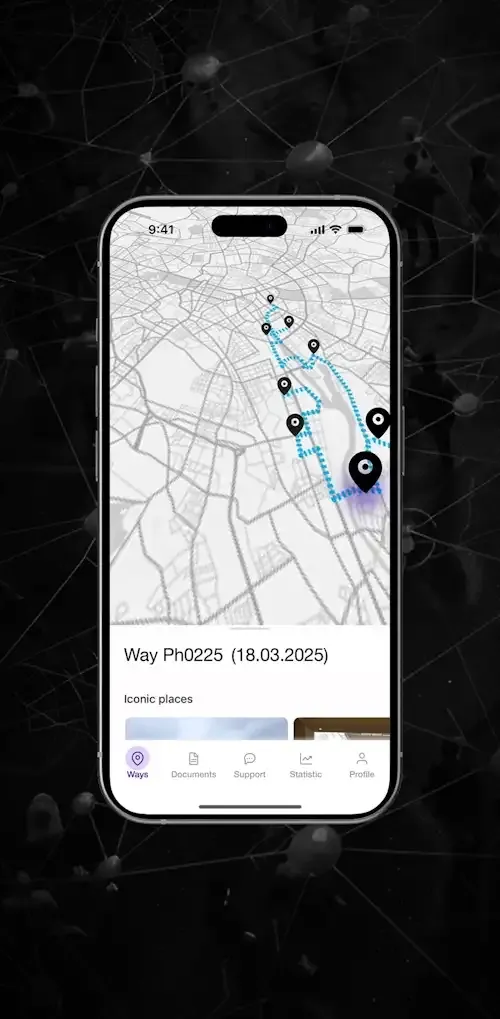
A data-driven GPS monitoring and routing system that helps sales teams work with higher efficiency and lower operating costs.
View caseThis was a very task-heavy project, mostly exploration and R&D-driven. However, by the end of WislaCode, we were left with a detailed roadmap consisting of clear milestones - able to be converted into tangible KPIs - and some neat ideas of what actionable are next. Integrating...
We collaborated with WislaCode on a route-to-market optimisation project. Working with WislaCode was effective, transparent and predictable, which is especially critical for AI and ML projects. We provided them with six months of anonymised data, and within just three weeks...
Working with WislaCode Solutions has been a great experience! We needed an Android SDK developed under a tight timeline, and their team delivered a flexible, user-friendly solution that integrated seamlessly into our ecosystem. Their transparent approach, proactive...
Commissioning software your business will run for years?
Tell us the process owners and the systems it touches and we will plan a build your IT can own.