


In 2024 and 2025, AI sits at the centre of B2B development, but real progress is more than switching AI on. The strongest B2B companies add AI in a planned, responsible and secure way, aiming for lasting impact. For banking and fintech, the point is not to use AI for its own sake but to apply it where it changes business results - managing AI risk, supporting staff and strengthening security.
Key trends shaping B2B development in 2024-2025
B2B development is changing fast, with AI at its core. Plenty of people still question how far AI really goes. Our work at WislaCode Solutions, building for banking, fintech and other sectors, shows how much responsible, well-run AI matters.
AI trust, risk and security management: the base of modern B2B solutions
As AI spreads, AI trust, risk and security management (AI TRiSM) has become essential, above all in regulated sectors like banking and finance. A clear AI governance framework limits the risks: wrong predictions, data breaches and damage to reputation.
- Build trust: keep models explainable, so it is clear how a decision was made - vital in financial use cases.
- Manage risk: assess pre-trained models and open-source tools carefully, with attention to data privacy and ethics.
- Put security first: use strong measures to protect sensitive data, such as financial transactions, from AI-related threats.
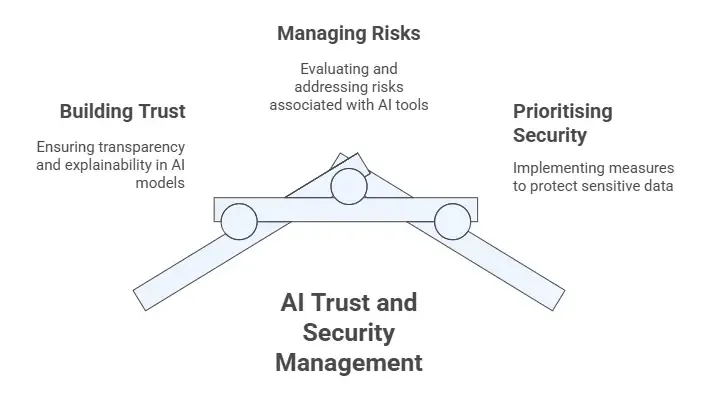
Gartner predicts that by 2026, organisations with strong AI TRiSM protocols will see a clear improvement in decision accuracy.
Supporting employees with AI: more productive, more creative
The idea that AI simply replaces jobs is changing. In practice, AI takes over repetitive work so people can focus on judgement and new ideas. In fintech, where speed and accuracy matter, that lifts productivity and frees staff for harder problems.
- Better skills: AI tools help staff build and sharpen their digital skills.
- Faster onboarding: training for new hires, even in complex fields like banking, can be automated to save time and money.
- Data-driven decisions: teams get AI insights and decide faster and better.
It also matters to deal with “shadow AI”, the unsanctioned use of AI inside a company. Enterprise-grade AI tools let B2B firms work securely and efficiently while keeping that risk down.
Industry cloud platforms: solutions built for the sector
One-size-fits-all SaaS often misses what B2B companies in finance, retail and other sectors actually need. Industry cloud platforms (ICPs) take a more tailored, modular approach.
- More flexibility: ICPs let firms adapt quickly to new rules and market shifts.
- Better workload management: handle workloads by data availability and client need - key in regulated industries like banking.
- Business impact: ICPs turn cloud into a business tool, not just infrastructure.
Gartner forecasts that by 2027, the large majority of enterprises will have adopted ICPs, a sign of growing demand for flexible, customisable cloud.
WislaCode develops modern solutions
Effective use of artificial intelligence requires a deep understanding of the entire ecosystem, including trust, security and flexibility.
Intelligent applications: meeting needs before they are asked
Clients now expect apps that anticipate their needs, not just react. Intelligent applications use AI to be proactive, responsive and personal.
- Proactive service: for example, insurance apps that start a claim from weather data, or banking apps that suggest the right product from customer behaviour.
For fintech firms, intelligent applications lift customer satisfaction, build loyalty and open new revenue.
Zero trust architecture: security for the age of AI
As attacks grow more sophisticated, zero trust architecture (ZTA) has become a foundational approach. In a zero-trust model, every user, device and app is verified continuously, wherever it sits on the network.
- Continuous authentication: keep verifying, using AI to read behaviour and spot anomalies in real time.
- Least-privilege access: give users and apps only the access they need, so a breach does less damage.
- Full monitoring: watch every endpoint to keep security consistent.
Many firms have started on zero trust, but full adoption is still hard. As AI takes a bigger role in security, zero trust will matter even more for B2B, especially in data-sensitive sectors like banking and finance.
Few successful projects of WislaCode


The future of AI in B2B development
AI is clearly reshaping B2B development, but getting the integration right takes a full approach. At WislaCode Solutions we see that effective AI adoption means understanding the wider picture: trust, security and flexibility. By focusing on AI TRiSM, supporting staff, adopting ICPs, building intelligent applications and applying zero trust, B2B firms can get the real value of AI, limit risk and hit their goals.
What are the key AI innovations for enterprises in 2025?
AI innovations for enterprises in 2025 focus on creating smarter, more adaptive solutions. These include predictive analytics for better decision-making, automated workflows to streamline operations, and enhanced customer insights through data-driven tools. Businesses are prioritising AI that integrates with existing systems, delivering measurable outcomes in sectors like finance and retail.
How are advanced AI technologies shaping B2B in 2025?
Advanced AI technologies for B2B in 2025 are transforming how companies operate by enabling real-time data processing and tailored solutions. For instance, AI-powered platforms in fintech improve transaction security and customer experience, while automation tools enhance supply chain efficiency. These technologies drive innovation while addressing sector-specific challenges.
What trends in AI development should businesses expect by 2025?
Trends in AI development for business by 2025 include a shift towards ethical AI, greater emphasis on explainable models, and integration with industry-specific platforms. Companies are focusing on responsible AI adoption, ensuring compliance with regulations and fostering trust, particularly in highly regulated sectors like banking.
Why is AI trust and security management critical in B2B?
AI trust and security management in B2B is essential to mitigate risks such as data breaches and biased algorithms. Enterprises are adopting AI TRiSM (Trust, Risk, and Security Management) frameworks to ensure transparency, protect sensitive data, and comply with regulations. This builds confidence among clients and stakeholders in industries like finance.
How do industry cloud platforms benefit B2B companies?
Industry cloud platforms offer modular, customisable solutions tailored to specific sectors, such as finance or retail. Unlike generic SaaS, these platforms allow businesses to adapt quickly to market changes, manage workloads efficiently, and comply with regulations, making them a cornerstone of modern B2B innovation.
What role do intelligent business applications play in B2B growth?
Intelligent business applications use AI to anticipate customer needs, delivering proactive and personalised experiences. For example, banking apps may suggest tailored financial products, while insurance platforms can automate claims based on real-time data. These applications enhance customer satisfaction and drive revenue growth.
How do zero trust security models enhance B2B cybersecurity?
Zero trust security models in enterprises ensure continuous verification of users, devices, and applications, reducing the risk of cyber threats. By implementing least-privilege access and real-time monitoring, businesses, especially in data-sensitive sectors like finance, can safeguard critical systems and maintain a robust security posture.