
AI integration services
Wiring AI into the product you already run – models, LLMs, APIs and agents integrated into your stack, with the monitoring and guardrails to operate them inside a regulated environment.
Results from work we have shipped
WislaSearch is an AI-powered search assistant that centralises fragmented data, indexes and retrieves the right information instantly, and keeps everything inside your own secure infrastructure.
Shortlisting a software development partner?
The questions to ask in an RFP, three warning signs a vendor may not deliver, and a scoring matrix to compare contractors objectively.
AI we integrate
Connecting a model, a vendor API or an in-house service to your product, with the adapters, retries and error handling to run it in production.
Wiring a language model and a retrieval layer into your app so it answers over your own documents and data, not the open web.
Dropping an agent into an existing process, where it gathers inputs, calls your systems, applies your rules and escalates the edge cases to a person.
KYC, fraud, document and vision vendors integrated behind one interface, with fallback and vendor-swap designed in from the start.
The plumbing that feeds a model live data and carries its output back into the systems that act on it.
Rate limits, cost controls, logging, refusals and human-in-the-loop checkpoints, so an integrated model is safe to leave running.
Connecting AI to the older systems a bank actually runs, where a clean API rarely exists yet.
How we deliver AI integration?
The same delivery discipline on every engagement - from the first map to a handover your team runs.
We map the systems, the data flow and the failure modes, then write a phased scope with the boundary decided up front.
We design the interfaces between your stack and the model or vendor, so either side can change without a rebuild.
We build the integration, add retries, guardrails and observability, and test it against the edge cases that break naive wiring.
Deployed in your cloud, monitored on latency, cost and quality, with a runbook handed to your team.
What shapes the work
Most AI does not fail on the model. It fails because the model never reaches the data or the workflow it was meant to change. An assistant that cannot reach the right records is a demo; a fraud model that cannot reach the payment stream is a research paper.
So the hard part of adding AI is rarely the AI. It is the integration: the contracts between systems, the live data, the error paths and the guardrails. That is the work this page is about, and it sits next to our API integration services and the applied modelling on AI development.
The data that makes an integrated model useful – your records, transactions and policies – is usually the data you cannot send to a public provider. We integrate for that constraint: self-hosted or private-endpoint models where capability allows, retrieval that keeps your data on your infrastructure, and contractual limits on any third-party endpoint. The full boundary approach is on the Data Science &
AI vendors change fast, and a model that is best today may be second-best or withdrawn next year. So we put a clean interface between your product and any model or vendor behind it, with fallback and a swap path built in. You get the capability without the lock-in, and swapping a provider becomes a configuration change rather than a rebuild.
AI integration rarely stands alone. If the goal is autonomous or assisted workflows, see AI agents development; if it is language and generation, see generative AI; if you need the model built as well as wired in, that is AI development. For the wider platform this connects to, see financial software development.
We prove the risky part first. A proof of concept on your own systems and anonymised data is fixed-price and time-boxed, answering one question: can the model reach the data and the workflow cleanly, inside your boundary. If it can, production follows as time and material or an outcome-based arrangement, with monitoring and guardrails built in from the first sprint.
What does AI integration include?
Connecting models, LLMs, APIs, agents and third-party AI services to a product you already run, together with the data pipelines, monitoring and guardrails needed to operate them in production. The integration work is usually larger than the model work: authentication, error handling, rate and spend limits, fallbacks, and the audit trail a regulated financial operation has to produce afterwards. WislaCode builds that layer for banks and fintechs, so the AI ships inside the product instead of beside it.
Can you add AI to our existing platform rather than rebuild it?
Yes, and that is most of this work. We wire a model, an API or an agent into an application or core system you already run, using the interfaces that exist rather than requiring the modern API you do not have. Adapters, error handling and observability come with it, so the new capability is operable from the first release and not after a second project.
Do you integrate third-party AI vendors, or only models we own?
Both, behind one vendor-neutral interface with a fallback path. For $lana (Monetech) we integrated two KYC providers with facial and document recognition behind a single interface, so the product did not have to change when the provider did. The same pattern covers fraud, document and vision vendors as well as models your own team has trained.
How do you keep an integrated model inside our compliance boundary?
The boundary is decided at design time: self-hosted or private-endpoint models where capability allows, your data kept on your own infrastructure, contractual limits on any third-party endpoint, and audit logging where the use case requires it. For EU institutions a dated obligation now sits on top of that. Article 50 of the EU AI Act, Regulation (EU) 2024/1689, has applied since 2 August 2026 and requires people to be told when they are interacting with an AI system, a duty the Digital Omnibus on AI, Regulation (EU) 2026/1744, did not defer when it moved the Annex III high-risk obligations to 2 December 2027. Deciding where a model runs and what it discloses before the build is cheaper than retrofitting both.
When is a custom model the right call rather than an off-the-shelf AI service?
An off-the-shelf service is often right for a general task such as summarising a document or classifying free text, and we will say so. A regulated decision is different: underwriting, fraud scoring or a KYC check usually needs a model scoped to your data and your rules, with the explanation and the audit trail a supervisor expects, which a packaged product rarely exposes. The practical test is whether you could reconstruct and defend one specific decision six months later, and where you cannot, integration alone will not fix it.
What should we look for in a team integrating AI into a regulated financial platform?
Ask where the model runs, who holds the data and what is logged on each call, before asking about model quality. Then ask to see the integration itself instead of a demo: the adapters, the retry and fallback behaviour, the spend and rate limits, and how a provider's breaking change is contained to one place. A team that can answer those inside your own repositories and your own cloud is doing integration work; a team that can only show you a model is doing something narrower.
How do you avoid AI vendor lock-in?
A clean interface sits between your product and any model or vendor, with a fallback and a documented swap path, so changing provider is a configuration change instead of a rebuild. In the EU that matters more than it used to. Under DORA, Regulation (EU) 2022/2554, every model API a financial entity calls is an ICT third-party arrangement recorded in the Article 28(3) register of information, and Articles 28 to 30 require an exit strategy that is documented and tested. We build the swap path because you will be asked to evidence it.
Who owns the integration afterwards?
You do. The source, adapters, pipelines and documentation are yours, running in your own cloud from the start and handed over with a runbook. No component depends on us to keep running, and no model provider is one you cannot leave.

A private, on-premise WislaSearch deployment that turns a logistics operator's scattered operational knowledge into instant, cited answers - without anything leaving their network.
View case
An AI-driven solution that optimises medical sales representative routes and improves field efficiency, using deep learning over visit patterns to predict the best routes.
View case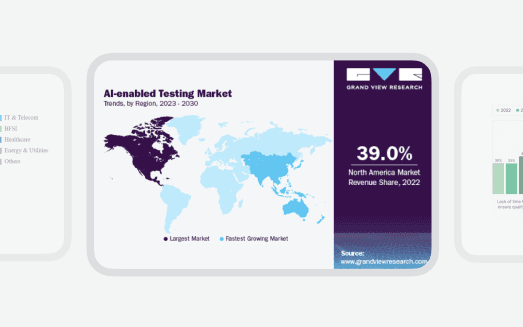
WislaCode helped Verysell Group Applied AI Lab explore the current state and future of AI testing, turning uncertainty into clear, actionable insights.
View caseWe've been working with WislaCode since July 2025. What started as enhancing the loyalty program in our GlobalTips guest app grew into a broader partnership where they now handle significant frontend development across our guest app, staff app, and web products.
This was a very task-heavy project, mostly exploration and R&D-driven. However, by the end of WislaCode, we were left with a detailed roadmap consisting of clear milestones - able to be converted into tangible KPIs - and some neat ideas of what actionable are next. Integrating...
We collaborated with WislaCode on a product strategy development project and gave the highest marks for this contractor. The WislaCode team delivered on time and with outstanding quality.
Have a model that needs wiring in?
Bring the capability you want to add and the systems it has to reach. We will scope an integration that proves the connection works, inside your boundary, fast.