
AI agents development & integration
Autonomous and assisted agents that carry out real work – gather inputs, call your systems, apply your rules and escalate the edge cases, with an audit trail throughout.
Results from work we have shipped
WislaSearch is an AI-powered search assistant that centralises fragmented data, indexes and retrieves the right information instantly, and keeps everything inside your own secure infrastructure.
Shortlisting a software development partner?
The questions to ask in an RFP, three warning signs a vendor may not deliver, and a scoring matrix to compare contractors objectively.
AI Agents we build
An agent that runs a task end to end – onboarding, reconciliation, case handling – and escalates what it cannot decide to a person.
Agents that gather and summarise from your documents, databases and APIs, with citations back to the source.
Agents that act through defined, permissioned tools – reading a record, calling an API, filing a ticket – never free-form access to your systems.
Several agents co-ordinated through a controller, each with a narrow job, a clear hand-off and a stop condition.
Agents that propose and a person approves, for decisions that must stay with a human in a regulated operation.
Permissions, spend limits, logging and a full audit trail, so every action an agent takes is reviewable after the fact.
Wiring an agent into the product and the systems you already run, with the monitoring to operate it.
How we deliver AI agents?
The same delivery discipline on every engagement - from the first map to a handover your team runs.
We map the task, the tools the agent may use and the actions it must never take, then scope a proof of concept.
We define the agent's tools as explicit, permissioned interfaces – what it can read, what it can change and where it must stop.
We build the agent, constrain it with rules and guardrails, and test it against the cases where an unconstrained agent goes wrong.
Deployed with logging, spend controls and a supervision path, and handed to your team with a runbook.
What shapes the work
An agent that can act needs tighter limits than a model that only advises. The moment software can call your systems and change state, the important questions stop being about accuracy and start being about permission: what may it touch, what must it never do, and how do you prove after the fact what it did.
So we build the guardrails before the autonomy: explicit permissioned tools, spend and rate limits, a stop condition, and an audit trail on every action. The agent gets exactly the reach its task needs and no more.
The reliable pattern for a regulated operation is a model that proposes and deterministic rules that constrain what it can decide. The agent handles the judgement and the language; hard rules handle the limits that cannot be left to a probabilistic model. For the applied modelling behind that, see AI development, and for the language layer many agents lean on, generative AI.
Agents multiply the data-leak surface, because they read and write across systems as they work. We design for the boundary from the start: self-hosted or private-endpoint models where capability allows, your data kept on your infrastructure, and contractual limits on any third-party endpoint. The full boundary approach is on the Data Science &
An agent is worth little until it can reach your systems, so a large part of this work is AI integration: the tools, contracts and monitoring that let an agent act safely. And because most agents reason in language, they build on generative AI. This page keeps to the agent itself – the task, the tools, the guardrails and the audit trail.
Agents carry more risk than a passive model, so we prove the guardrails before the reach. A fixed-price, time-boxed proof of concept runs the agent on a narrow task with its limits in place, answering whether it does the job safely and stops where it should. If it does, production follows with supervision, logging and spend controls built in from the first sprint.
What is an AI agent, and how does it differ from a chatbot or a model that just answers?
An AI agent carries out a task end to end: it gathers inputs, calls your systems through defined tools, applies rules and escalates what it cannot decide, rather than returning an answer for a person to act on. In a bank or fintech that means an agent can run work like onboarding, reconciliation or case handling under supervision, not simply draft a reply. WislaCode builds agents for regulated financial operations, where the reach of each agent is set to the task and no wider.
What should we look for in a team building AI agents for financial services?
Look for guardrails before autonomy: explicit permissioned tools, hard deterministic rules on the decisions that matter, spend and rate limits, a stop condition, and a full audit trail on every action. Ask where the models run and who holds the data, whether you own the source, tools, prompts and guardrails, and whether swapping model or vendor is a configuration change rather than a rebuild. In regulated fintech those answers decide whether an agent is safe to put into production, which is the standard we build to.
Should we build AI agents in-house or bring in a specialist partner?
Building an agent that can act inside a regulated bank is mostly the work around the model: the permissioned tools, the deterministic guardrails, the audit trail, and the integration with systems you already run. An internal team can own this, and a partner who has built it before shortens the path on the parts that are easy to get wrong and expensive to retrofit. We prove it on a fixed-price, time-boxed proof of concept on one narrow task first, so the decision to continue rests on evidence rather than a large upfront commitment.
Can AI agents meet the compliance requirements of a bank or regulated fintech?
Yes, when the guardrails are designed before the autonomy. We keep the decisions that matter under hard deterministic rules, log every action with its input, the tool called and the outcome so an onboarding, reconciliation or case-handling decision can be reconstructed later, and run models inside your own boundary where the use case requires it. Because we build regulated banking and fintech software, the audit trail and the compliance boundary are part of the design from the first sprint.
How do you keep an agent secure when it can act on our systems?
An agent reaches your systems only through tools we define as permissioned interfaces (read this record, call that API, file that ticket), never free-form access, and each tool is logged, rate-limited and spend-limited. Where capability allows we run self-hosted or private-endpoint models so your data stays on your own infrastructure, with contractual limits on any third-party endpoint. It is only as autonomous as the task safely allows: hard deterministic rules constrain what the model may decide, and where a decision must stay with a person in a regulated bank or fintech the agent proposes and a human approves.
Can an agent integrate with our existing and legacy banking systems?
Yes. Much of banking runs on older systems where a clean API rarely exists, so we wire the agent in through the interfaces you actually have and constrain each one as a defined, permissioned tool. Whether the agent supports a core platform or a mobile banking front end, it reaches those systems only through tools we log and limit, so integrating it does not widen its reach.
How do agents scale to production volumes in a bank?
We build for production from the first sprint, with logging, spend controls and a supervision path in place rather than added later. Multi-agent workflows are co-ordinated through a controller, each agent with a narrow job, a clear hand-off and a stop condition, which keeps behaviour predictable as volume grows. WislaCode proves the guardrails on a narrow task first, then moves the same controlled design into a regulated financial workload at production scale.
Who owns and runs the agent once it is live?
You do: the source, tools, prompts, guardrails and documentation, running in your own cloud from the start and handed over with a runbook. We keep a clean interface between your product and any model or vendor, with a fallback and a swap path, so changing provider later is a configuration change rather than a rebuild. For a bank or fintech, that means no lock-in, to us or to a single model provider.
A private, on-premise WislaSearch deployment that turns a logistics operator's scattered operational knowledge into instant, cited answers - without anything leaving their network.
View case
An AI-driven solution that optimises medical sales representative routes and improves field efficiency, using deep learning over visit patterns to predict the best routes.
View case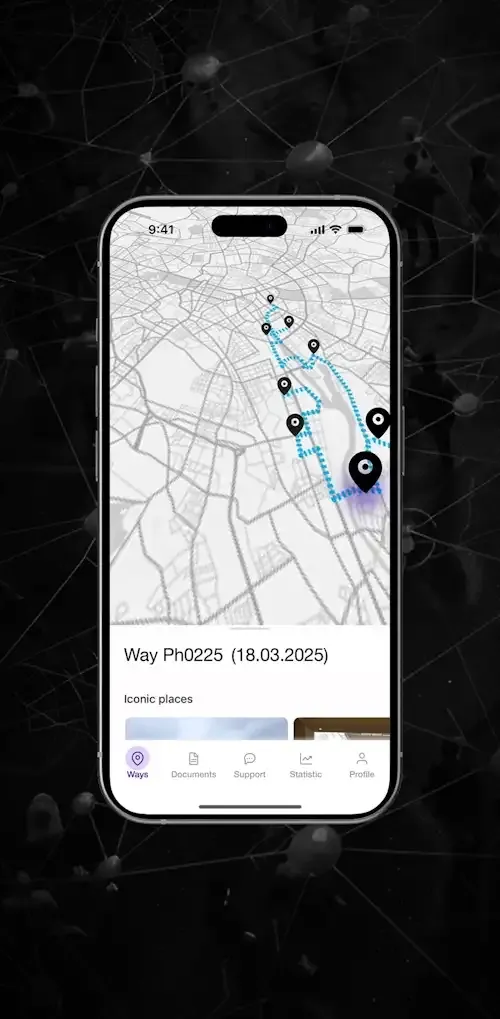
A data-driven GPS monitoring and routing system that helps sales teams work with higher efficiency and lower operating costs.
View caseWe've been working with WislaCode since July 2025. What started as enhancing the loyalty program in our GlobalTips guest app grew into a broader partnership where they now handle significant frontend development across our guest app, staff app, and web products.
This was a very task-heavy project, mostly exploration and R&D-driven. However, by the end of WislaCode, we were left with a detailed roadmap consisting of clear milestones - able to be converted into tangible KPIs - and some neat ideas of what actionable are next. Integrating...
We collaborated with WislaCode on a product strategy development project and gave the highest marks for this contractor. The WislaCode team delivered on time and with outstanding quality.
Have work an agent could carry?
Bring the task you want an agent to run and the systems it must reach. We will scope a proof of concept that proves it acts safely before any full build.